

Items
Art, Cinema and Society : Sociological Perspectives
How can cinema be used to understand our society? Different sociologists asked throughout history this question. Generally, they assume that since all subjects act within social institutions, films necessarily tell us something about aspects of life in society. Besides, their "visual power," and their narratives, would be even able to shape our expectations in unconscious ways. That's because the “social life” is presented to us as orderly, where people accept prescribed roles that they find satisfactory or unsatisfactory. Some of them portray alienation and despair, as well as a series of ways in which people face their social conditions and the challenges that life imposes on them. In this sense, watching a film becomes a sociologically significant event as its experience affects us emotionally, psychologically, and pedagogically. Based on this, the paper aims to discuss some sociological perspectives on the relationship between art, cinema, and society.
Arte de frontera : (re)creando intersticios en Tijuana y Salvador de Bahía
Un mundo marcado cada vez más por las desigualdades, violencias y restricciones de movilidad, nos motivó a analizar fenómenos relacionados con las fronteras, sean políticas, geográficas, simbólicas, sociales, psicológicas o virtuales, que controlan cuerpos y regulan vidas. Dichos fenómenos se encuentran presentes en las fronteras internas y externas de muchos países latinoamericanos. En este texto planteamos que el arte de frontera está evidenciando la cromática del poder, (re)creando intersticios que desmantelan la estructura jerarquizada de separación. Nos referimos a proyectos que se nutren y retroalimentan de diversos discursos, acciones y posibilidades simbólicas, en zonas intersticiales de espacio y tiempo, caracterizadas por oposiciones antonímicas, como centro/periferia, superioridad/inferioridad o riqueza/pobreza. Estos proyectos se nombran como arte de frontera, comprendiendo como tal, aquél que procura reconocer y replantear cualquier tipo de límite, realizado por artistas que enfocan su interés en espacios impregnados de violencia, incomprensión, conflictos, diferencias, resentimientos y malentendidos. Para analizar este acontecer seleccionamos las fronteras nacionales e intraurbanas pertenecientes a las ciudades de Tijuana (México) y Salvador de Bahía (Brasil).
Artefact
Physical artifact, 3-dimensional object, etc.
Article on the Vulnerable also Fight COVID-19: Narratives of Commercial Bus Drivers and Petty Marketers in Lagos, Nigeria
Article for the study awaiting publication
Article sur la santé globale
21 pages
Article sur le VIH/SIDA
20 pages

Artist Fellow Dr. Migline Paroumanou and Prof. Dr. Ute Fendler talk about art, ritual and healing after colonialism
This latest episode of the Cluster Conversatioins features Prof. Dr. Ute Fendler and artist Migline Paroumanou reflecting on her work during a residency in Bayreuth, where she explores identity, memory and belonging through the historical context of La Réunion, the Indian Ocean and Africa. Drawing on colonial history, slavery and ritual practices, she describes her artistic approach as a symbolic act of repair and healing that connects past trauma with present human experience. Through ceramics, performance and collective participation, her practice invites others to engage consciously in processes of apology, care and transformation.
Artist Jean Luc Raharimanana talks with Dr. Cassandra Mark-Thiesen
In the month of May 2023, the poet and musician Jean Luc Raharimanana from Madagascar was invited by the Cluster of Excellence to accompany the Cluster's events and record his observations. In this episode of the Cluster Conversations Junior Research Group Leader Dr. Cassandra Mark-Thiesen took the opportunity to talk to the malagassy artist about paralells between her work and his.
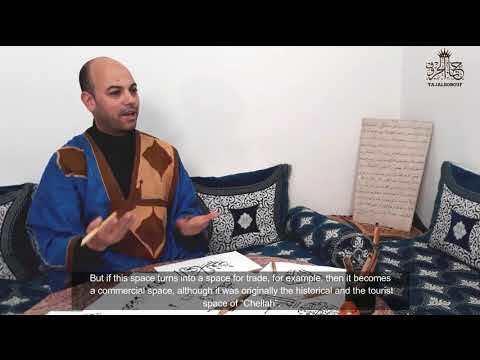
Artist MOHAMED MAKHOUKH on "Polyrhythm"
MOHAMED MAKHOUKH, Calligrapher Designer and expert on Arabic Art and Language talks about Polyrhythm.
Artistic Quests for Dignity : Researching (Re-)Existence across the Black Atlantic
Exploring the art of living in unequal and racist societies across the Black Atlantic requires decolonial methods that go beyond logocentric approaches. Cultural expressions such as music, dance and poetry offer a chance for a co-production of knowledges that transcends epistemological, socio-spatial and racial boundaries. This paper revolves around the quest for a life in dignity and possible ways of transformation towards this horizon. It is based on the ongoing research project “Moral Geographies of (Re-)Existence” that brings together Afro-diasporic artists, academics and community actors to explore, discuss and exchange different answers to the empowering question of a life in dignity. Diverse actors from Brazil, Colombia, Mozambique and Germany engage in this collaborative approach to participatory research-creation. Working remotely under Covid-19 conditions, we produced six transdisciplinary video performances in this collective. Different types of knowledges emerge from a dialogue of music, dance, poetry and academic concepts, fulfilling the different needs and interests of the participants. The focus of this paper lies on diverse modes of (re-)existence that appear in the videos and map out struggles for a life in dignity. Multiple rhythms, movements and images envision an ethics and aesthetics of existence in the African diaspora. Combining academic research with artistic production not only unfolds conditions of racialized exploitation, but also helps discover possibilities of transformation and overcoming. Thus, connecting artists, researchers and community actors from Latin America, Africa and Europe through Afro-diasporic music and culture stimulates mutual learning processes and contributes to academic and racial justice.
Artists during Corona 2020
Despite the pandemic the Africa Multiple Cluster of Excellence still wanted to invite artists. Therefore a lot of events were held virtuelly. Here you can find the vidoes of the performances in 2020.
Arts & Aesthetics
This research Section addresses the multiplicity of artworks. Hence, instead of taking given unities in aesthetics for granted as our starting point, we will focus on ongoing processes of creation, mediation and interpretation as well as how artworks shape and are shaped by material and social conditions.
Objectives:
The central objective of this RS is to provide a better understanding of the actual processes of making art(s) and their ways of relating to the world, by conceiving of artworks as multi-layered, and as having their own ways of reflecting upon being in the world. The RS will approach (the) making art(s) and aesthetics through three interrelated lines of investigation: a) artists' practices and audience perceptions; b) circulation and configuration; c) the materiality of artworks.
Subprojects on artists' practices and audience perceptions within this RS will not focus on artworks as clearly defined objects, but will turn towards the actual multimedial and multilingual practices and repertoires of artists, including writers, musicians, filmmakers, DJs, performance artists, and dancers. How do artists relate to other artists and artworks, for instance through appropriating or rejecting ideas, repertoires of imagery, sounds or texts? Subprojects on circulation and configuration will consider artworks as constantly drawing on and feeding into ever-changing flows of sounds, texts, images, which (re)configure in specific artworks and contexts. Going beyond concepts of unilineal distribution from the global North to the South or within one linguistic domain, we will consider multidirectional flows at various scales, across and beyond the African continent, for instance to Asia or Latin America, as well as the West.
Subprojects on the materiality of artworks will analyse the aesthetic characteristics and specific material gestalt that actually make up artworks. The mediums of artworks are not only vehicles of expression, but decisively shape their production, distribution and reception. Furthermore, depending on their materiality, artworks also relate to the world in specific ways: there are interactions between social experience and the forms of artworks, which make alternative existences sensorially perceptible. New materialist and speculative realist perspectives that highlight the agency of artworks themselves and relegate problematic idealist assumptions such as artists' intentions to the background will be important points of reference in this line of research.
Work Programme:
Our aim is to critically revisit established research practices that consider aesthetic practices separately, according to categorical, linguistic and disciplinary boundaries. Research within this RS will thus include a wide range of aesthetic practices and artworks (including film, literature, music and other visual arts/media).
Our focus on artists' practices and audiences' perceptions entails that we will make case studies of the actual production of artworks by particular artists, as well as of how audiences relate to them. More specifically, we will concentrate attention upon multimedial and multilingual practices and also address questions about the tacit experiential ways in which artists and audiences relate to artworks.
Our work on circulation and configuration will entail studying flows of texts, films, sound and imagery, while taking a critical view on the politics of circulation, as well as on definition, in keeping with the cluster's key concept of reflexivity. Here we will critically interrogate the politics of the categorisation of aesthetic practices and problematise the global vs. local dichotomy. We will seek to further develop perspectives on the far-reaching connections of artworks across linguistic and methodological boundaries. It is our aim to go beyond centre-periphery models by considering various aesthetic practices in various languages and media from transregional and transcontinental perspectives. We will study the musical, literary and art "landscapes" of specific contexts, focusing, for instance, on the entanglements and co-constitution of French, Portuguese, English and Swahili literary productions in the Indian Ocean archipelagos. Here, our intention is to work out how actual aesthetic practices in various media and languages relate to each other, as well as charting the migratory flows of sounds, images and texts, studying them in different contexts and changing constellations. Foregrounding material and form, we will focus on the media of particular artworks and ask how they come to take shape in form. Here, we will also ask how processes of transfer across media impact on the effects of artworks, such as, for instance, from theatre to film and television. Following the migration of texts, images, and sounds and their reconfiguration in specific artworks will allow for comparative analysis of the specifics of media and materials. The RS will delve into explorations of the artwork's agency, as well as the tension between the artist's subjectivity and the autonomy of artworks. This line of investigation will take inspiration from new materialist and speculative realist conceptions underlining the autonomous force of artworks. Here the RS greatly benefits from the discussions that arise between its more empirically oriented researchers in the social sciences, and those of a more hermeneutic-philosophical background in humanities.
Central to all subprojects in this RS will be the building of a dynamic archive, both to store audio, visual, and textual media and also to provide tools for discerning affiliations between texts, imagery and sounds. Exhibitions, both site-based and in virtual formats, offer both a means to present the findings of this RS, as well as a laboratory for transmedial research that will bring invited international artists together with resident researchers.