In Egypt, many women have created various private Facebook groups for women only to support women. As exclusive spaces for women, these Facebook groups enabled women in Egypt to share their experiences and quickly became a source of awareness. Concurrently, their proliferation and popularity as spaces exclusively encompassing thousands of women have attracted extensive mass media coverage in Egypt, particularly from talk show programs. Accordingly, this article uses critical discourse analysis to explore the discourses on popular women-only Facebook groups in mainstream talk show programs in Egypt. Ten talk show program videos were analyzed to identify the discourses on these Facebook groups. The article displays conversations from four talk show program segments to showcase two prevalent and simultaneous discourses. The first discourse conveys a moral panic over these Facebook groups for enabling women to discuss problems on matters of the private sphere. Conversely, the second discourse conveys an embracement of Facebook group creators’ entrepreneurial practices manifested from their Facebook group. Subsequently, these two discourses are critically analyzed by drawing on literature on gendered dynamics of the private and public spheres in Egypt and postfeminism in connection with commercial media logic.
We use the case of Northern Tanzania to put empirical flesh on the idea of diverse economies. We advance the idea that smallholder production systems offer ontological and practical resources to envision and perform more viable African rural futures, potentially with important lessons for the rest of the world.
The challenges of researching “up” are widely acknowledged. Moreover, these hurdles are intensified for law and courts field investigators where the profession’s cherished virtues – protocol, hierarchy and decorum – hamper access to interviewees and could potentially be detrimental to rapport building for the researcher unfamiliar with courtroom formality. This paper draws on the author’s field experience to highlight the potential of the informal dimension of fieldwork – “hanging out” – in traversing some of the limits of researching legal and judicial elites. It teases out the complexities of studying judges as political actors and the peculiar circumstances of studying legal elites in close-knit circles. Through “hanging out” at relevant court events, strategically positioning oneself in social events and informally building rapport, the author gained access to spaces usually closed off to outsiders. By “hanging out” with judges, the author challenged her perceptions of absolute judicial fidelity to the law, interrogated their professed devotion to apoliticism and the experience humanised judges and helped her deal with her own discomfort with interviewing judges. The paper concludes by weighing the promises and limits of the informal approach to researching legal and judicial elites, pondering ethical considerations, the researcher’s positionality and the boundaries of continuous residence.
In both Bolivia and Benin, the state presumes that citizens can navigate its bureaucracy even if it does not provide them with the requisite literacy skills. However, bureaucratic procedures are highly characterised by literacy and digital literacy and people with little or no literacy require alternative strategies to manage them. This article contributes to debates on (il)literacy and bureaucracy studies by looking at the learning practices of persons with little or no literacy competence in La Paz and El Alto, Bolivia, and Parakou, Benin. It investigates their ways of coping with such bureaucratic requirements and especially how they manage to acquire specific literacy abilities in order to complete procedures. Our conclusions are based on empirical data obtained through various kinds of interviews and participant observation that we carried out during more than 12 months of fieldwork.
The Dragonfly Sea by the Kenyan author Yvonne Adhiambo Owuor moves away from the West as the constant historical and geographical point of reference. This novel rewrites ancient and recent relations between East Africa and China (also Turkey) and puts an emphasis on far-reaching connections in the Indian Ocean. Rather than land, it is the shape-shifting, unsettling sea, larger than human life—its waves, surfs, currents, and scents, but also its pirates and container ships—which takes poetic center-stage in the novel. I start by exploring the ocean as a potent, productively opaque metaphor which defies stable representations, but underlines an aesthetic relationship to place and belonging. I argue, with reference to Glissant, that it safeguards relationships from assimilation into predefined and coercive discourses and also foregrounds a multitude of possible ways of knowing. Furthermore, the novel suggests a similar approach to language. A multitude of language and cultural repertoires figure—often untranslated and unexplained: Swahili proverbs, verses from taarab songs and children’s rhymes, Islamic formulas and calligraphy and Chinese pictograms disrupt the English narrative and challenge the reader. The novel foregrounds each language’s Eigensinn, but also, and even more so, the irreducible sensuous body of every language. With Emily Apter’s notion of ‘untranslatability’, I argue that ‘untranslation’ is a powerful act and meta-comment in the Dragonfly Sea, a novel that makes an effort not to ‘tame’ languages, treating them as easily substitutable. I demonstrate that productive moments of astonishment and discomfort arise in those parts of the text in which we hear, see and are made to ‘taste’, as the novel says, other languages and repertoires.
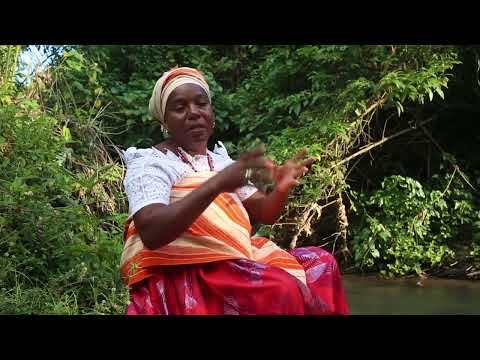
This is a trailer for the film “Yabás: Mulheres do Bembé do Mercado” (2019) by Laís Lima.
In this film, Laís Lima tries to rescue the role of women who participate and sustain the tradition of Bembé do Mercado but who somehow remain in the background or “private spaces”. Nevertheless these women have an integral role in the rituals which take place during all the stages of the celebration. With Yabás, Laís Lima sought to give them a voice, recognition, and equal importance for the realization and preservation of Bembé do Mercado.
Laís Lima will take part in the 2022 Cluster Conference on Medialities.
To find out more about her work please visit: https://www.africamultiple.uni-bayreuth.de/en/Research/1research-sections/art_aestethics/Bembe-do-Mercado/index.php