Auteur-Acteur-Compositeur-Dramaturge-Fondateur de maison de culture-Ancien Dj de bals poussière, Nassur Attoumani, le porteur de multiples casquettes fidèle à son casque colonial est l’une des voix artistiques les plus importantes de l’archipel des Comores. Dans cet entretien Nassur Attoumani parle des langues d’écriture et des identités littéraires, des réseaux littéraires, de l’écrivain « postcolonial » comme traducteur (in)conscient, du lectorat absent, de la crise humanitaire liée à la « migration » des îles d’Anjouan, de Mohéli et de la Grande-Comore vers Mayotte et du mythe du casque colonial qu’il porte fièrement depuis plusieurs décennies.
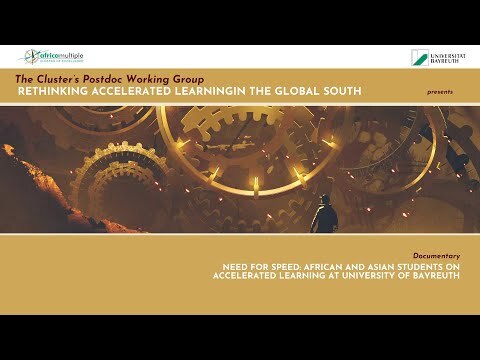
The Postdoc Working Group's workshop in February was accompanied by a film screening of documentary "Need for Speed: African and Asian Students on Accelerated Learning at University of Bayreuth". The film explores the experiences of African and Asian students navigating accelerated learning programmes at University of Bayreuth, highlighting both challenges and opportunities. The film examines how accelerated learning impacts students' academic adaptation, career preparedness, and cultural integration. The screening provided a platform for discussions on inclusivity and the future of higher education in a rapidly evolvling global landscape.
"O sonho puído" is an expanded poem by the artist Deisiane Barbosa developed from performances, video art and urban interventions, with the participation of the group Marias da Ladeira, in São Félix – BA. It integrates the poetic narratives of the expanded book inventário /da ilha\ de Tereza, which
Deisiane Barbosa had been unfolding since the artistic residency for writers at the Instituto
Sacatar, in 2016. O sonho puído was edited from 5 actions between the cities of São Félix,
Cachoeira and Salvador – BA.
The project is part of the panel "Body as a medium" which will be represented at the 2022 Cluster Conference on Medialities.
Governmental and non-governmental actors promoting the universalisation of energy access and a just energy distribution for all envision spatial energy justice and recognition. Yet how and the extent to which these considerations offer practical solutions to the energy needs and visions of different social groups simultaneously is less evident. This is particularly crucial in Ghana where a just, ‘state-driven’ electricity provision connotes recognition of privileges of citizenship and an aura of ‘modernity’. Many urban households in Ghana are keenly installing Solar Home Systems (SHS) to mitigate frequent grid power outages and ensure stability in the performance of social and energy-saving practices which grant them recognition as ‘enlightened’ social groups or as individuals staying au courant with modern energy technologies. Also, the Ghanaian government recently attempted to achieve spatial energy justice by providing free 500 W SHS to non-electrified, ‘territorially remote’ communities. Many community residents, however, claim the SHS facility restricts performances of ‘modern’ practices in comparison to fellow ‘Ghanaians’ who have access to electrical grids and that its acceptance may perpetually reduce them to ‘second-class’/‘old-fashioned citizens’. Our empirical evidence suggests that energy justice visions remain fuzzy unless they are set in relation to how and why practical solutions to the energy ‘needs’ and ‘visions’ of socially and spatially differentiated groups could be realised. We call this practical recognition. In this paper, we advocate practical recognition as a suitable alternative pathway for researching just energy futures by emphasizing connections between justice, human agency and entitlement notions.
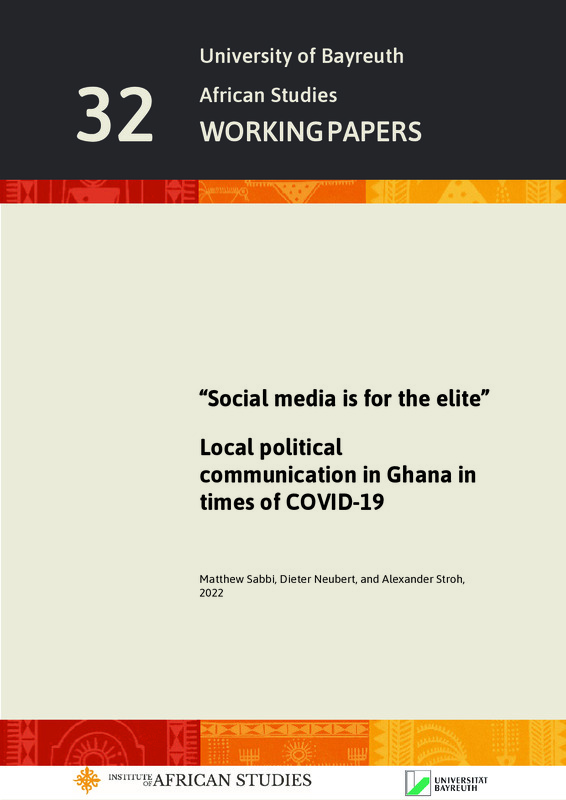
With the spread of smartphones in Africa, social media applications particularly WhatsApp, Facebook and Twitter offer due to their commentary function a platform for political debate but also for political communication. We ask whether and how local administrations use this communication channel. We draw on our study of social media platforms in three selected districts in Ghana and examine the contents of local political discussions on these platforms. Although the topics of debate often vary according to local contexts, the outbreak of the COVID-19 pandemic presents crosscutting concerns that affect both urban and rural districts. We analyse topical issues communicated on the platforms as well as how local people react to those topics. Insights from earlier fieldwork and recent interview data allow us to compare the congruence between the topics of social media debates with the everyday contents of local political debates. We conclude with observations and hints on the methodological challenges of online research.
The narratives of Community-Based Organisations (CBOs) are significant for linguistic analysis as they provide natural data in highly emotional public discourses. In Kenya, any topic or discourse on land injustice is a highly emotive venture. In the same vein, public narratives are relevant to provide evidence for evaluations of language choice, power, and authority, as well as the linguistic communication of emotion. In this respect, emotion-provoking narratives are highly important phenomena that are hardly ever absent in the public discourse of CBOs advocating for land rights. Within the framing rhetoric of social movements, we explore how these groups frame land injustices within emotion-provoking narratives in public discourse. The methodology in this study involved audio-recorded data collected from two CBOs that represent land injustices due to government and/or company-propelled projects in Kenya: Tugen Hills Forests Right Holders and Kerio Valley Professionals Association based in Kabarnet town in Baringo county. Significantly, Kerio Valley Professionals Association advocates for land rights for communities along the border of Baringo county and Elgeyo-Marakwet county. The analysis reveals the following frames within narratives in the discourse of Kenyan CBOs addressing land injustices: victim, good vs evil, bad governance, and insecurity of tenure as strategic negotiation characters that constitute a prerequisite for legitimisation and proper enactment of land laws. At the same time, these narrative frames are laden with emotions such as anger, frustration, despair, and fear. Therefore, this research sheds light on how CBOs navigate for land rights by use of frames within narratives, particularly in public discourse, to sanction their emotional expressions as positive for the movements in order to bring about resistance and change for the benefit of the community.