Ouma lays bare the subtleties and complexities of far-right alliances in the geopolitical arena, Africa’s entanglement in these dramas, and imaginable global futures for the continent
The Africa Multiple Cluster of Excellence conducts its research in five Africa Multiple Research Centres in Burkina Faso, Germany, Kenya, Nigeria, and South Africa. They form a transcontinental network dedicated to reconfiguring African Studies through collaborative inter- and transdisciplinary research.
Emerging from the Cluster’s first funding phase (since 2019), the AMRCs evolved from a structure with Bayreuth as lead and four African Cluster Centres into a more integrated, horizontally connected model that emphasises institutional parity and shared governance. Thus, in its second phase (AM 2.0), the Cluster pursues its agenda through five interconnected centres.
Together, the AMRCs constitute a closely connected research infrastructure, jointly advancing research, digital innovation, early-career support, gender and diversity initiatives, and South–South cooperation in African Studies.
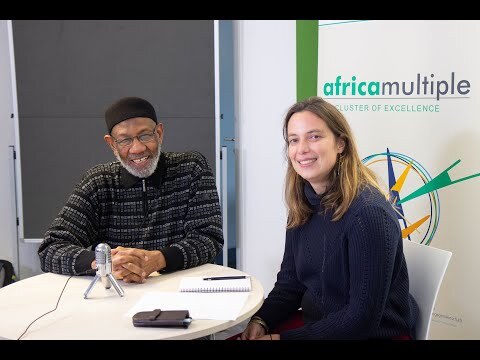
Abdilatif Abdalla who was in Bayreuth as guest for the series of events on the Indian Ocean, in conversation with Clarissa Vierke, Professor of Literatures in African Languages at the University of Bayreuth.
Abdilatif Abdalla is a Kenyan poet, publicist and university lecturer and considered one of the best-known Swahili poets of the present day. Since 1995, Abdalla has taught Swahili at the University of Leipzig.
The boom in South–South relations since the early 2000s has seen a flurry of investment in African infrastructure from emerging markets across the Global South. While the extent to which these projects spur growth is constantly debated, few studies have addressed their impact on ground-level political and socio-economic practices in Africa—or their consequences for transnational governance more broadly. Through the lens of infrastructure, this book investigates the developmental ideas, processes and techniques that have travelled to and emerged from Africa as a result of Global South–led projects. How have they been adapted, transformed and contested by local actors? How does this shape business–society relations? And how has this challenged the Western-dominated global order? The contributors zoom in on large-scale Chinese-, Brazilian- and Indian-funded ventures—dams, ports, roads and mines—across countries including Kenya, Mozambique and the DRC. These ‘frontier zones’, bringing together politicians and practitioners, campaign groups and communities from Africa and elsewhere, offer a unique insight into the global workings of our contemporary world. Taking a bottom-up approach, Africa’s Global Infrastructures explores the longer-term significance and implications of these pluralistic socio-economic interactions, for the continent and beyond.
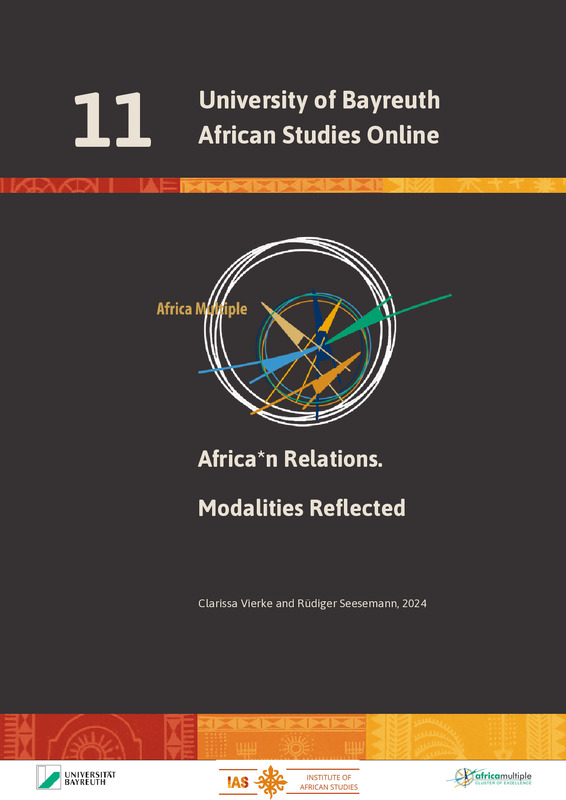
This special issue “Africa*n Relations. Modalities Reflected” comes out of the first conference of the Cluster of Excellence Africa Multiple. Reconfiguring African Studies, which took place from 14th to 17th July 2021. Like the conference, the special issue is dedicated to the cluster’s annual theme and heuristic angle of modes of relating. In the overall research agenda of the Africa Multiple, the notion of relationality takes centerstage. With the focus on Africa not as a given but as a multiple constantly in the making, relations through which it is constituted and upated necessarily come to the fore. Our attention is drawn to processes, appearances and practices and hence to the variety of modes of coming into relation. Accordingly, next to medialities, spatialities, and temporalities, modalities is a heuristic angle in Africa Multiple meant to structure the study of relations we encounter in African lifeworlds, which can take a vast spectrum of forms, like e.g. exchange, acceptance, adaptation, convergence, dependence, hierarchization, conflict, struggle, resistance, and denial. Furthermore, modalities is fundamentally interlinked with the Africa Multiple Cluster’s key concept of reflexivity, which requires the researchers to reflect upon the relational modalities of their position and the very conditions of their knowledge production. This issue’s six contributions which approach modes of relations from a variety of perspectives and with a view on different African countries and their diasporic links, were written by scholars from a variety of disciplines, namely, sociology, geography, anthropology, religious and literary studies and philosophy. Furthermore, in line with critically reflecting upon the modalities of academic knowledge production, it also contains contributions by two artists, the French photographer Aurélien Gillier, who enters in a dialogue with the sociologist Joschka Philipps, and the Kenyan author Yvonne Ahdiambo Owuor, who critically reflects on creative forms of knowledge production on and in Africa.
The image of South Korea abroad is very much dominated by the political heritage of the Korean War and the divide between North and South Korea. The armistice since the end of the war and ongoing threats from the North justify the massive presence of US American forces close to the capital Seoul, such that American popular culture and especially African American popular culture are very present in the music scene. Parallel to the historical legacy of the war, South Korea has succeeded in creating a positive image by using the soft power of popular culture over the last twenty-five years, since the 2000s; the leading music groups that have become representative of South Korean popular culture draw much from African American popular culture when it comes to songs, dance and fashion. This article will follow three phenomena illustrative of this trend: the first is situated in the music industry, where big enterprises and the indie scene are striving for diversity while facing fluid convergences; the second is the phenomenon of K-dramas produced by Netflix. The argument will follow a chronological order so that the interaction between music, performance, production and series becomes visible. Finally, reggae, as a very specific music genre representing freedom and diversity, will illustrate the marginalized status of an indie scene with occasional connections to hip-hop. These examples provide some insight into the in/visibility of African American and African popular culture in South Korea and the struggle for diversity in a country based on the myth of being a monoethnic nation.
The Africa Multiple Cluster of Excellence has four partner institutions that have the status of African Cluster Centres (ACC): the University of Lagos (Nigeria), Moi University (Eldoret, Kenya), Université Ouaga 1 Professeur Joseph Ki-Zerbo (Ougadougou, Burkina Faso), and Rhodes University (Makhanda/Grahamstown, South Africa). The ACCs serve as nodes for joint research initiatives and networks within the cluster and are the main partners in the cluster’s endeavor of reconfiguring African Studies.
In this playlist you can find interviews with members of the different ACCs.