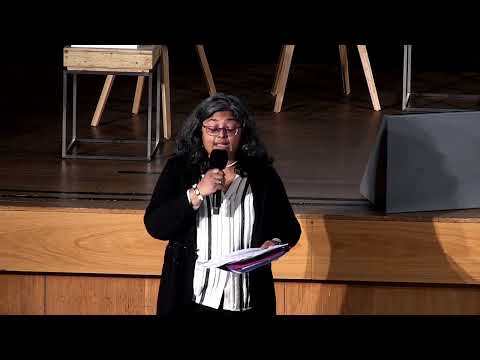
This Afro-Feminist Round Table will engage with decolonial feminism from francophone and anglophone African perspectives with a view to generating valuable insights in intersectional and decolonial epistemic frames pertinent to the Cluster’s agenda of reconfiguring African Studies. This intergenerational, transdisciplinary conversation has been is a sharing of thoughts and teachings from the speakers‘ diverse situated standpoints.
Decolonial feminisms are epistemic frames to name and address all modes of systemic oppression. The conceptual tools implemented mobilize the knowledges produced by racialised women in the Global South throughout history, whereby transformative justice informs decolonial feminist visions.
Knowledge production by racialised women has for the most part been about articulating life worlds and situated knowledges which have otherwise been consigned to the margins, dehumanised and/or erased. These knowledges form the bases of knowledge currently produced by Global South women scholars and activists working for much-needed transformative justice and life-affirming visions of futures.
Moreover, decolonial feminism generate modes of care and hope as viable frams for envisioning African Futures for both established and early career scholars.
Roundtable participants:
Dr. Fatou Sow (sociologist and education scientist; Cheikh Anta Diop University, Dakar, Senegal and Centre National de Recherches Scientifique (CNRS) in Paris, France)
Prof. Ousseina Alidou (African Literatures and Languages; Rutgers University, USA)
Prof. Akosua Adomako Ampofo (sociologist, African and Gender Studies scholar; University of Legon, Accra, Ghana)
Prof. Francoise Verges (political scientist and historian; Fondation Maison des sciences de l’homme, Paris, France)
Chair:
Dr. Christine Vogt-William, Director GDO, Africa Multiple Cluster of Excellence, University of Bayreuth
The roundtable is designed as a pre-event for the award ceremony of the honorary doctorate for Dr. Fatou Sow later the same evening. It will be streamed online and may be attended via Zoom.
For more info please download the flyer.
If you would like to join the event via zoom please register with africamultiple-gdo@uni-bayreuth.de
This book discusses the status and importance of decolonisation and indigenous knowledge in academic research, teaching, and learning programmes and beyond. Taking practical lessons from a range of institutions in Africa, the book argues that that local and global sciences are culturally equal and capable of synergistic complementarity and then integrates the concept of hybrid science into discourses on decolonisation. The chapters argue for a cross-cultural dialogue between different epistemic traditions and the accommodation 'Indigenous' knowledge systems in higher education. Bringing together critical scholars, teaching and administrating academics from different disciplines, the chapters provide alternative conceptual outlooks and practical case-based perspectives towards decolonised study environments.
In this article I aim to contribute to a more multifaceted picture of what decolonising education can mean. I do this in the form of a case study of selected and intertwined Bolivian–German discourses and practices directed at the decolonisation of education in the wide sense of the term. First, I introduce Indigenist and ‘Indianist’ proposals, which are shaped, not least, by Nietzschean ideas. In a second step, I turn to some examples of German ‘Bildungsromane’ that are deeply entangled with Bolivian phenomena. Hence, the first part of the article is about decolonising the formerly colonised via education, whereas the second revolves around decolonising the former colonisers, but without the possibility for or the wish to identify completely clear-cut boundaries. It will thus become clearer how decolonising education can be understood as a relational phenomenon.
The call for the decolonization of knowledge refers to both its colonization and contingency and puts the focus on the multiplicity of knowledge. This contradicts European-North- American thinking and definitions of knowledge. Consequently, to advance an epistemological decolonization of knowledge, the actual process of defining knowledge will be analysed and the multiplicity of perspectives stressed at the epistemological level. Using Indian epistemology as an example, I will work out differences in definitions of knowledge and therefore basic diversifications in describing and explaining the emergence of knowledge. Truth-value-neutral forms of knowledge in particular challenge dominant European-North-American philosophical definitions, which incontrovertibly include assumptions of true or false knowledge. An interesting overlap between some Indian epistemologies and postcolonial theories can be observed with regards to the central role of the contextualization of knowledge production and the socially embodied nature of scientific knowledge in general. If the incentives gained are to be taken seriously, the consequences for educational science in general as well as educational practices must be discussed. According to the findings of organizational theory, emphasis on diversification and complication is also seen as an opportunity for the emergence of fresh meaning. Referring to Helen Verran’s concept of generative tension as a sign of collective creativity, encounters between diverse forms of knowledge and epistemological principles are seen as sources of creative processes and prerequisite for the emergence of new positions, perspectives etc., and thus as incubators for innovations.
This paper examines the relationship between visuality, knowledge and power in the postcolonial African novel. With examples from selected texts of Ngugi wa Thiong’o and Sony Labou Tansi, it argues that visual culture, usually employed in the analysis of cultural images and material iconographies in media studies, can aptly be employed in textual analysis given that postcolonial novels are primarily engaged with the undoing of dominant visual regimes. Against the background of hegemonic regimes based on instrumentalist and subjectifying surveillance of the subject, Ngugi wa Thiong’o and Labou Tansi build their texts on visual tactics and practices that subvert the capacity of the state apparatus to see, hence to know the subject. Bordering on humour, parody, graffiti, bricolage and surrealist representation, the two authors “play” with the state Panopticon, creating avenues for countervailing meanings that elude the dominant regimes of vision, knowledge and power. The subversive visual practices are inscribed within a conception of literary textualities that is based on plurivocality, heteroglossia, dialogism and the non-transparent text. Through the deconstruction of dominant visual architecture, both authors open up spaces for democratic conception of power that takes account of inter-subjectivity and non-hegemonic participation in the postcolonial public sphere.