This essay introduces the concepts of astropoetics and cosmopoetics to describe literary manifestations of astroculture in the twentieth-century novel. It suggests that astropoetic texts are media of astroculture, bringing their formal conventions and traditions to bear on the particular questions raised by attempts to instil outer space with human meaning. For the student of literary history, astropoetics thus offers a specific window onto the history of poetics and criticism. Drawing on the history of metaphors and Hans Blumenberg’s metaphorology, the essay explores how these concepts illuminate the novel genre’s epistemology, ontology, and anthropology. By tracing the interplay between cosmic order and literary meaning, it argues that astropoetics and cosmopoetics offer a framework for understanding the novel’s potential for producing knowledge, its nature as ‘real’ or ‘imagined’, and its function as a medium of expression. The essay concludes by examining the ‘Ithaca’ chapter from James Joyce’s Ulysses as a key modernist text that exemplifies the self-reflexive potential of cosmopoetics in the novel.
In a contribution to ROAPE’s debate on capitalism in Africa, Stefan Ouma provides a critical account of Africapitalism as well as an assessment of the future/s it imagines, what it silences and its potential to transform African economies. Ouma concludes that the ecologically destructive and dehumanizing architecture of our global economic system provides further evidence to condemn any variant of capitalism.
In this video, Prof. Dr. Martina Drescher and Dr. Oumarou Boukari talk about their research project "Health discourses as moral communication? Linguistic case studies from Côte d'Ivoire and Cameroon" that they conduct as part of the Cluster's research section "Moralities".
The project examines manifestations of ethics or morality – two concepts we use interchangeably – in everyday talk by zooming in on health communication in Cameroon and Ivory Coast. It draws on constructivist and phenomenological conceptualizations of ethics by assuming that there are no moral phenomena as such, but that ethics is intimately tied to interaction.
More info on the project here: https://www.africamultiple.uni-bayreuth.de/en/Projects/Moralities/Moralities_Health_Drescher/index.php
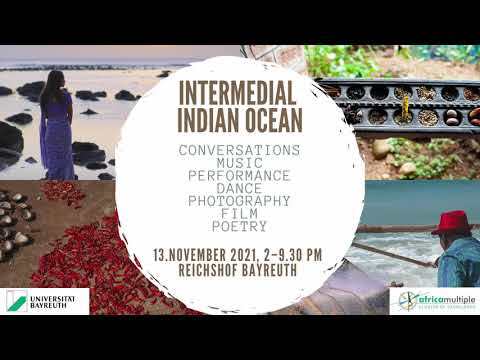
On 13 November 2021, Prof. Dr. Ute Fendler and Prof. Dr. Clarissa Vierke invited the interested public to an exciting and eventful day dedicated to the Indian Ocean. Music, films, dances, photographs and poetry transported the audience to the East African region, whose artistic and medial forms of expression are often shaped by the beautiful landscape and maritime lifestyle in which they were created.
In the evening the event even saw the world premiere of filmmaker Harrikrisna Anenden's "Draupadi's veil".
This recording shows part of the event. The performances of musician Tao Ravao, dancer Luis Sala and a poetry performance of Abdilatif Abdalla and Clarissa Vierke.
An interview with Boubacar Boris Diop by Rémin Armand Tchokothe in the particular circumstances of a tour on the Holocaust Museum in Nurembererg. The author of Murambi reminds of the Jewish genocide's memory compared to the genocide in Rwanda. The conversation then evokes the writer's stay at the University of Bayreuth: an opportunity to pay tribute to African studies in Germany and to speak in favour of reinforcing studies in African languages in Africa.