

Publications
Origins & context
- Title
- Publications
Items
Genre in World Englishes : Case Studies from the Caribbean
World Englishes and English in postcolonial contexts have been curiously neglected in an otherwise abundant research literature on text types and genres in English. This volume looks at the adaptation, transformation and emergence of genres in the particular cultural context of the Anglophone Caribbean. A comprehensive framework for the investigation of text production in postcolonial and global English communities is followed by empirically based case studies on specific text formats such as recipes, death notices and obituaries, letters to the editor, newspaper advice columns, radio phone-in programmes, online forums and the music genre calypso. Influences from oral versus literate culture as well as status and function of English versus Creole are considered by highlighting written, spoken and digital genres. All chapters present surveys from a historical and cross-cultural perspective before exploring specific linguistic and cultural features in the Caribbean texts. This volume will be highly relevant for researchers in World Englishes and Caribbean studies, postcolonial pragmatics, genre and media studies as well as linguistic anthropology.
Gesellschaft und Umwelt
Die Schriftenreihe wird unter Federführung des Geographischen Instituts der Universität Bayreuth herausgegeben und präsentiert überwiegend fachwissenschaftliche sowie fachdidaktische Arbeiten, die im Rahmen der Fortbildungsveranstaltung ‘Kontaktstudium Geographie’ für Lehrkräfte vorgestellt werden.
Ghana's Debt Crisis and the Political Economy of Financial Dependence in Africa : History Repeating Itself?
Recent accounts of the re-emergence of debt distress in Africa, while offering significant insights, fail to provide the historical political-economic context within which African indebtedness is set. On the surface, spending induced by the COVID-19 pandemic, economic fallout from the Russia–Ukraine war, and repeated examples of fiscal indiscipline by African governments appear to be the causes of the current wave of debt crises. Beyond these factors, however, this article argues that the present indebtedness, like previous episodes, is rooted in the economic and financial subordination of African economies. Specifically, the article places Ghana's extensive debt within the country's post-independence political-economic context, and thus traces the structural factors and external constraints that underlie its economic vulnerability and financial dependence. These include the collapse of developmentalism in the 1970s, the Structural Adjustment Programmes of the 1980s, and an exploitative transnational lending system dominated by Western commercial creditors. Internally, recent fiscal mistakes by the government, within its limited policy space, have exacerbated Ghana's indebtedness. The Ghanaian experience shows that unconditional debt cancellation, widely called for, is a necessary but insufficient measure to address the recurring cycles of indebtedness. Debt cancellation should be followed by broader economic and financial reforms, globally and domestically.
Ghosts, spectres, revenants : Hauntology as a means to think and feel future
Hauntology, as as theoretical perspective, opens a field to discuss presence and absence, visibility and invisibility also beyond Literary, Religious or Visual Studies. It relates the lingering of presumably ‘failed’ ideas to the concept of ‘ghosts’ and specters as the haunting presence of past or simultaneously present futures. The scholars and artists contributing to this volume dis-cussed these conceptual outlines in a series of transdisciplinary events, hosted by the editors. The concept proved particularly fruitful in the context of the discourse on global migration, European border politics and the re-emergences of nationalism and right-wing and straight men politics. Hauntology in this context enables to see that the so-called crises lie somewhere very different: Not in the movement of people but in the dispensation of wealth and access throughout the world. The present we live is embedded in the presence of ghosts and specters, and the traces of imag-inations of different times and spaces may become visible and doable. Art in its various forms is the integral part of the hauntological discussion. As such, the contributions by Kitso Lynn Lelliott (Johannesburg), Simon Vincent (London), Silhouette Tapes (Bayreuth/Berlin), Danilo Barata (Cachoeira), Spoek Mathambo (Johannesburg), Henriette Gunkel (London), Esther Peeren (Amsterdam), Renzo Baas (London), Ute Fendler (Bayreuth), Kathrin Rothe-mund (Bayreuth), Jörg Skiebeleit (Berlin/Flossenbürg), Ibrahim Mahamat Zene (Bayreuth/ N’Djamena) and others sound the field of hauntology for the future. Stipulating hauntological thinking may help to see, feel and listen to worlds radically different from the “capitalist realism” (Fisher) of the contemporary.
Globally Circulating Educational Concepts and Multiplicities of Contexts in India and Africa : A Relational Perspective on the Educational Sector
Firstly, I will discuss the diffusion approach before explaining an alternative view that is more suitable for a postcolonial perspective. I combine the concept of trading zones of knowledge with a network theory perspective. Afterwards, trading zones of knowledge and reciprocity are addressed, and I offer an example of a circulating educational concept of the nineteenth century. This is followed by an analysis of reasons for the global circulation of educational concepts today. In the last section, I discuss the alternative realities of the majority world, and try to explain why school education may be unproductive in such contexts.
Governing Refugee Mobility : Contrasting Genealogies of Encampment in Uganda and Kenya (1930s to 1990s)
Most scholars and humanitarian practitioners agree that refugee encampment does more harm than good. Nevertheless, camps are still a major dispositif to govern the mobility of refugees in Africa. However, there exist striking differences in the refugee host policies of different African countries. One explanation for this difference can be traced to the specific historical trajectories and genealogies of refugee encampments. This paper highlights these differences by contrasting the histories of Kenyan and Ugandan encampment policies from the colonial to the postcolonial period. In Uganda, the first refugee camps were established in the 1940s for Polish refugees, followed in the 1950s by Sudanese and Rwandans fleeing violence related to independence conflicts. Especially in setting up the camps for Rwandan refugees, Ugandan officials mainly followed existing plans for agricultural settlements. In the context of the post-war “developmental colonialism” the Ugandan government regarded the refugees as assets for settling underpopulated regions, combat animal diseases and increase productivity. In Kenya, the first refugee camps were set up in the 1930s for Ethiopian refugees from the war with Italy. Strictly supervised and placed in the arid Northern Frontier District, these refugees were not supposed to form permanent settlements but to return as soon as feasible. The most extensive camp system in Kenya developed in the 1950s and consisted of the internment camps during the counterinsurgency war against Mau Mau. The post-colonial government continued the practice of internment during the Shifta War in the 1960s to 1970s. The Kenyan policy of refugee encampment developed in the 1990s out of this legacy of securitization. Today, Uganda’s policy of granting rights and land to refugees stands in stark contrast to Kenya’s restrictive encampment policies. In Uganda, refugees were seen as resources for cultivating land whereas in Kenya they were regarded as a danger and possible competitor over the already contested lands. In this paper, I argue that history and socio-economic structures play a crucial role in understanding these differences. Based on archival research and historiography, this paper argues that refugee camps are locally specific yet globally entangled mobile devices for the care and control of mobile people.
Harmonie ist eine Strategie : Gattungs- und Formwissen in Ali Smiths "Brexit-Roman" Autumn (2016)
Ali Smith’s novel Autumn (2016) immediately acquired near-canonical status in academic discussions of ‘BrexLit’, i.e., literary responses to the 2016 British referendum on leaving the European Union. This chapter considers the functions of Autumn’s self-conscious references to the Victorian genre of the ‘Condition of England’ novel. It argues that the older genre’s central premise – the idea that England is divided into ‘two nations’ – is explored in Autumn as a potential pattern for making sense of the current political situation. However, Smith dismisses the standard solutions offered by that genre’s conventions, especially the dialogue between the divided ‘cultures’ within the nation, as model responses. In the process, ‘genre knowledge’ (Gattungswissen) and ‘form knowledge’ (Formwissen) are exposed as conventions disappointing the hopes placed in them. Still, the function of literature and art as repositories of historical models for problem solving is affirmed: the post-referendum ‘Remainers’ are presented as deeply disorientated, and the novel suggests that a cure for their despair may be found in a ‘shared’, cosmopolitan and European archive, rather than in an isolationist national tradition.
Historical Amnesia at Work: Reflecting about the "Absence in the Presence" of Female Authors in Saharan Arabic Manuscript Collections
Saharan historians have often argued that women were integral to the local Islamic scholarly culture. These women frequently took on crucial roles such as teaching, writing, counselling, spiritual guidance and legal orientation. However, only very few historical sources document these activities. Starting from a list of authors, the analysis focuses on cultural remembering techniques that help preserve local intellectual achievements and illustrates how women were systematically excluded from local documentation of erudition. The author argues that due to established gendered practices within the traditional local Islamic scholarly culture, texts written by women were most likely to be at risk of disappearing. This is a classic example of historical amnesia at work. Nonetheless, approved details about women’s presence in Islamic intellectual life led to the conclusion that in the Saharan intellectual tradition, there is an “absence in the presence” of female Islamic scholarship.
Histories from the Eternal Love Television Archive (Liberia), 1980–1991
This collection of essays documents the formative decades of African history across two countries by following the career of a British historian-cum-archivist Paul Jenkins (born 1938 in Sutherland) from West Africa to Central Europe. It retraces his academic path from Ghana to Switzerland while engaging his curiosities in, contributions to, and impact on the development of African history since the 1960s. The volume reflects on Paul’s academic services throughout the 1960s and 1970s, mainly at the University of Ghana (1965–1972) and subsequently at the Basel Mission Archive and University of Basel (1972–2003) in Switzerland – as key sites where he established himself as a teacher and promoter of African history. These episodes led to lasting bonds of intellectual friendships between Paul and an array of inter-/national and -generational scholars of Africa, several of whom are contributing to this volume. Significantly too, the volume highlights the importance of resources Paul curated during the early 1970s, notably his “Abstracts of the Basel Mission’s Gold Coast Correspondences”, through which he increased access to the rich collections of the Basel Mission Archive for scholars of Africa. Altogether, the essays celebrate, engage, interrogate, and push beyond Paul’s numerous past publications and ongoing academic work.
Holocene fire dynamics and their climatic controls on the southern Cape coast of South Africa : A 7.2 ka multi-proxy record from the peatland Vankervelsvlei
Fire is a natural phenomenon along South Africa's southern Cape coast, but identifying its climatic drivers has been a subject of considerable debate. This study investigates the hydroclimatic and fire dynamics from a 9.6 m sediment core from Vankervelsvlei covering the past 7.2 ka. The fen is located near the southern Cape coast within the year-round rainfall zone of South Africa. A reconstruction of hydroclimatic variability through time applies oxygen isotopes from hemicellulose-derived sugars and hydrogen isotopes from leaf wax-derived n-alkanes. Coupling both isotopes enables a reconstruction of the atmospheric source and seasonality of precipitation as well as estimating local relative humidity. Past trends in fire activity are inferred from macro-charcoal and polycyclic aromatic hydrocarbon (PAH) analyses, the latter serving as fire biomarkers. Results indicate high fire activity at Vankervelsvlei accompanied by generally moist conditions and a year-round rainfall regime linked to both Westerly-derived winter precipitation and Easterly- and locally-derived summer precipitation from 7.2+0.2/−0.2 to 4.5+0.3/−0.3 cal ka BP. From 4.5+0.3/−0.3 to 1.5+0.4/−0.2 cal ka BP, a shift to a Westerly-derived winter rainfall regime is identified. This variation features alongside reduced fire activity and persistent drought conditions as Easterly- and locally-derived summer precipitation decreased. From 1.5+0.4/−0.2 cal ka BP until present day, macro-charcoal and PAH accumulation rates show high fire activity. Paleoclimate evidence from the last two millennia suggests a variable climate with an overall increase in total moisture availability as contributions from both Westerly-derived winter precipitation and Easterly- and locally-derived summer precipitation support the year-round rainfall regime present today. Results from Vankervelsvlei support previous evidence from regional paleo-reconstructions, refining our understanding of the interplay between hydroclimatic variability and fire activity along South Africa's southern Cape coast. Our study discusses the role of large-scale climate modes, specifically the intensity of El Niño, as a potential driver of short-term hydroclimatic variability, which in turn drives fuel availability and fire activity at Vankervelsvlei during the Holocene.
How Can Literary Works Help Us to Understand the Politics of Migration?
The island of Mayotte forms part of the Comoros archipelago in the Indian Ocean. While Mayotte is part of France and the EU, other islands of the archipelago like Grande Comore and Anjouan are not. In this video, REMI TCHOKOTHE analyzes the tensions that this situation has caused, focusing on how they have been expressed in literary works. Employing close readings of writings by Nassur Attoumani and Soeuf Elbadawi alongside critical geography and field observation, Tchokothe notes that, for these authors, historically established patterns of internal movement between the islands cannot constitute illegal migration. Noting how both authors employ the French language as a tool of resistance, Tchokothe highlights the vital, ongoing role that literature can play in the process of decolonization.
How do current and past mining activities affect water security, health, and economic opportunities?
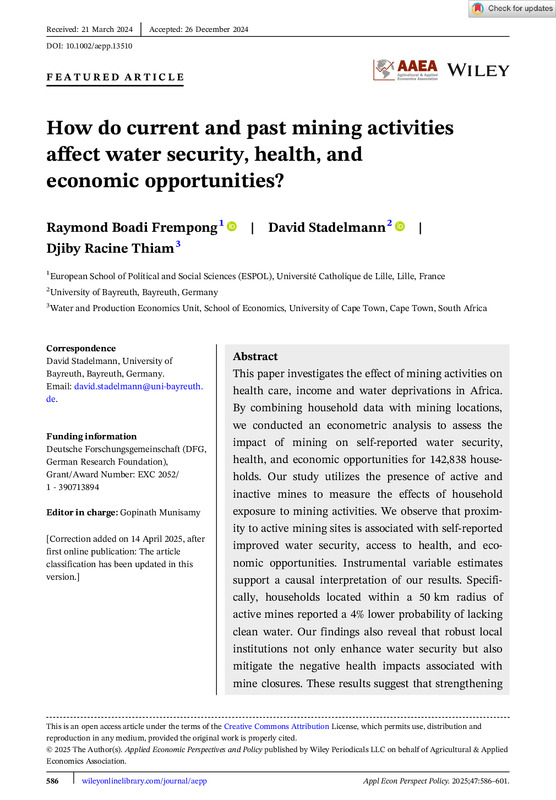
This paper investigates the effect of mining activities on health care, income and water deprivations in Africa. By combining household data with mining locations, we conducted an econometric analysis to assess the impact of mining on self-reported water security, health, and economic opportunities for 142,838 households. Our study utilizes the presence of active and inactive mines to measure the effects of household exposure to mining activities. We observe that proximity to active mining sites is associated with self-reported improved water security, access to health, and economic opportunities. Instrumental variable estimates support a causal interpretation of our results. Specifically, households located within a 50?km radius of active mines reported a 4% lower probability of lacking clean water. Our findings also reveal that robust local institutions not only enhance water security but also mitigate the negative health impacts associated with mine closures. These results suggest that strengthening local governance can amplify the potential benefits of mining operations. Therefore, we recommend the strengthening of local government institutions to foster the resilience of vulnerable mining communities.
How political is the "middle class" in Kenya?
The current debate presents the middle class in the Global South as a driver of democratic change and the core of civil society. The activities of NGOs, or student protests, for instance, seem to support this notion. However, these examples should not be overstretched. Before confirming the idea that the ‘middle class’ is a carrier of political protest and a driver of democratic change, we need to answer at least two questions. Is the ‘middle class’ really a class in the strict sociological sense, with a common class consciousness or just a group with a middle-income: ‘middle income group’? And are the protests really representative of the middle-income group? Taking Kenya as an example, we cannot identify a ‘middle class’ in the strict sense of the sociological class concept. Neither does the political commitment of the middleincome group follow socio-economic differences. More important are patterns of socio-cultural differentiation that can be conceptualised as socio-cultural ‘milieus’.
How political is the middle class in Kenya?
The current debate presents the middle class in the Global South as a driver of democratic change and the core of civil society. The activities of NGOs, or student protests, for instance, seem to support this notion. However, these examples should not be overstretched. Before confirming the idea that the ‘middle class’ is a carrier of political protest and a driver of democratic change, we need to answer at least two questions. Is the ‘middle class’ really a class in the strict sociological sense, with a common class consciousness or just a group with a middle-income: ‘middle-income group’? And are the protests really representative of the middle-income group? Taking Kenya as an example, we cannot identify a ‘middle class’ in the strict sense of the sociological class concept. Neither does the political commitment of the middle-income group follow socio-economic differences. More important are patterns of socio-cultural differentiation that can be conceptualised as socio-cultural ‘milieus’.
How to Surprisingly Consider Recommendations? A Knowledge-Graph-Based Approach Relying on Complex Network Metrics
Traditional recommendation proposals, including content-based and collaborative filtering, usually focus on similarity between items or users. Existing approaches lack ways of introducing unexpectedness into recommendations, prioritizing globally popular items over exposing users to unforeseen items. This investigation aims to design and evaluate a novel layer on top of recommender systems suited to incorporate relational information and rerank items with a user-defined degree of surprise. Surprise in recommender systems refers to the degree to which a recommendation deviates from the user’s expectations, providing an unexpected yet relatable recommendation. We propose a knowledge graph-based recommender system by encoding user interactions on item catalogs. Our study explores whether network-level metrics on knowledge graphs (KGs) can influence the degree of surprise in recommendations. We hypothesize that surprisingness correlates with specific network metrics, treating user profiles as subgraphs within a larger catalog KG. The achieved solution reranks recommendations based on their impact on structural graph metrics. Our research contributes to optimizing recommendations to reflect the network-based metrics. We experimentally evaluate our approach on two datasets of LastFM listening histories and synthetic Netflix viewing profiles. We find that reranking items based on complex network metrics leads to a more unexpected and surprising composition of recommendation lists.
Human trafficking : The approach of the African Committee of Experts on the Rights and Welfare of the Child
This chapter examines the effectiveness of the African Children’s Committee in addressing child trafficking through a balanced approach. To support this argument, the authors present three key sub-arguments. First, they contend that the Committee’s normative framework provides sufficient guidance for tackling child trafficking. Second, they suggest that while the Committee’s institutional framework shows promise, it requires further strengthening to ensure its adequacy in addressing child trafficking. Lastly, the authors propose that an analysis of the Committee’s jurisprudential developments can inform future strategies for combating child trafficking. In passing, the approach of the African Children’s Committee requires improvement to make it more effective. A conclusion and recommendations follow.