

Publications
Origins & context
- Title
- Publications
Items
Colonial rodent control in Tanganyika and the application of ecological frameworks
At the end of the 1920s, Tanganyika Territory experienced several serious rodent outbreaks that threatened cotton and other grain production. At the same time, regular reports of pneumonic and bubonic plague occurred in the northern areas of Tanganyika. These events led the British colonial administration to dispatch several studies into rodent taxonomy and ecology in 1931 to determine the causes of rodent outbreaks and plague disease, and to control future outbreaks. The application of ecological frameworks to the control of rodent outbreaks and plague disease transmission in colonial Tanganyika Territory gradually moved from a view that prioritised 'ecological interrelations' among rodents, fleas and people to one where those interrelations required studies into population dynamics, endemicity and social organisation in order to mitigate pests and pestilence. This shift in Tanganyika anticipated later population ecology approaches on the African continent. Drawing on sources from the Tanzania National Archives, this article offers an important case study of the application of ecological frameworks in a colonial setting that anticipated later global scientific interest in studies of rodent populations and rodent-borne disease ecologies.
Comment : Cultural Identities in Multilocal Spaces : bringing in multiplicity
The comment emphasizes upon the trinity of identity, space and connections or relations, referring to the contributions of the special issue. This perspective is used to ask for a concept of culture capturing the relationality of the social. Following the relational approach, any social actor has many identities while moving permanently between many social figurations, as e.g. network theory (White 2008) as a theory of the betweeness points out. Accordingly, a conceptualization of multiplicity of identities is a necessary component of theoretical approaches that catch up with these insights in a general emphasis on multiplicity (e.g. of space). What becomes visible is, that to grasp the multiplicity, fluidity and dynamics as well as the interdependency of identities and spaces (multilocal or else), their relationality must be focused upon. This challenges older disparities like local-global as well. In that sense, relationality is the key to bring identities, spaces and cultures together and integrate them into one concept that is capable of describing and analysing such different experiences represented in this volume.
Commentary on "The Monkey's Profession" (مهنة القرد في الغابة) and "One Way" (ذهاب بلا عودة): Practical observations on form-knowledge in translation
My position in this chapter is a comfortable one for an academic: it is not my expertise, but my ignorance that is requested. I have been asked, as a “third party”, that is, as a non-native speaker of either language, to consider translations from Arabic into English.
Commodities
Dieses Handbuch ist ein umfassendes und aktuelles Nachschlagewerk, das einen Überblick über den Stand der Finanzgeographie bietet. Mit dem Brexit, einer durch die COVID-19-Pandemie ausgelösten globalen Rezession sowie neuen Finanztechnologien, die das Finanzwesen zu revolutionieren drohen und dies auch versprechen, befindet sich die Landkarte der Finanzwelt in einem Zustand der Transformation, mit erheblichen Auswirkungen auf die Entwicklung. Vor dem Hintergrund dieser Entwicklungen baut dieses Handbuch auf dieser beispiellosen Dynamik auf und antwortet auf diese epochalen Herausforderungen, indem es einen umfassenden Leitfaden zur Finanzgeographie bietet. Die Finanzgeographie befasst sich mit der Untersuchung von Geld und Finanzen in Raum und Zeit und deren Auswirkungen auf Wirtschaft, Gesellschaft und Natur. Das Buch besteht aus 29 Kapiteln, die in sechs Abschnitte gegliedert sind: Theoretische Perspektiven der Finanzgeographie, finanzielle Vermögenswerte und Märkte, Investoren, Intermediation, Regulierung und Governance sowie Finanzen, Entwicklung und Umwelt. Jedes Kapitel bietet einen ausgewogenen Überblick über den aktuellen Wissensstand, identifiziert Probleme und diskutiert relevante Debatten. Geschrieben in einem analytischen und ansprechenden Stil von Autoren aus sechs Kontinenten aus einem breiten Spektrum von Disziplinen, bietet das Werk auch Überlegungen darüber, wo die Forschungsagenda in Zukunft wahrscheinlich voranschreiten wird. Das Buch richtet sich in erster Linie an Studenten und Forscher in den Bereichen Geographie, Urbanistik, Global Studies und Planung, die mit der Finanzgeographie mehr oder weniger vertraut sind und einen Überblick über den aktuellen Stand der Forschung in diesem Bereich suchen. Es wird auch für Studenten und Forscher anderer Disziplinen nützlich sein, wie z.B. Finanz- und Wirtschaftswissenschaften, Geschichte, Soziologie, Anthropologie, Politik, Wirtschaftswissenschaften, Umweltstudien und andere Sozialwissenschaften, die einen bequemen Zugang zur Finanzgeographie als einem neuen und relativ unbekannten Gebiet suchen. Schließlich wird es eine wertvolle Ressource für Praktiker im öffentlichen und privaten Sektor sein, einschließlich Unternehmensberatern und politischen Entscheidungsträgern, die nach alternativen Ansätzen zum Verständnis von Geld und Finanzen suchen.
Comparison of pasture types in the tropical Andes : Species composition, distribution, nutritive value and responses to environmental change
Pastoralism is the main land use in the humid tropical Andes of South America. Wide areas of mountain rainforest have been cleared for gaining pastureland. Due to the lack of indigenous useful grasses in the pristine forests, mainly exotic grass species have been used for establishing the pastures. In the Ecuadorian Andes, Axonopus compressus, Melinis minutiflora, Pennisetum clandestinum and Holcus lanatus are common pasture grass species. Their preference for certain microsites resulted in a mosaic of different pasture types, which reflect the differing ecological conditions on the undulating terrain of the mountain slopes. During the last decades, however, another exotic grass species, Setaria sphacelata has widely been introduced which, because of its fast growth on some of the sites could successfully suppress the formerly dominant plant species. With respect to the changing microclimate and cattle stocking rates the present study explored, whether planting Setaria is the best option for the common low-input type of pasture farming in these tropical mountains. In a study over twenty years, the development of four main pasture types, dominated by the above-mentioned grass species was investigated in areas with and without Setaria, and their topographical occurrence on the sloping terrain was analyzed. On forty-eight plots a pairwise (with or without Setaria) comparison of species composition and diversity, biomass production, forage quality and soil properties was performed. Although Setaria grows faster than the other grass species, its productivity was only higher on flat terrain. The nutritive value of the Setaria plots was at best equivalent to that of the former pastures, while species richness was consistently lower. Our results suggest the maintenance of a terrain-adapted diversification of the pastures and in particular the use of Setaria only on flat terrain.
Contestations over Agricultural Production in Colonial Africa
Agricultural history has enjoyed a rebirth in recent years, in part because the agricultural enterprise promotes economic and cultural connections in an era that has become ever more globally focused, but also because of agriculture's potential to lead to conflicts over precious resources. History is replete with stories of armies standing or falling as a result of their supply of agriculturally produced commodities. Civilizations have likewise succumbed because of famine or crop-related pestilence, highlighting the critical nature of agriculture to both regional and global society. The importance and fragility of agricultural systems will come into much greater focus because of climate change in the twenty-first century, something farmers the world over have begun to reckon with. As its implications are manifested in droughts and floods that hamper crop production, urban people will become ever more conscious of their own reliance upon agriculture. The contemporary critical evaluation of agriculture reflects a transition from a framework that celebrated the positive aspects of the evolution of agriculture to one that also explores its negative implications, such as the emergence of intensive and extractive agriculture that has worked to the detriment of indigenous peoples and disrupted traditional political economies. The Oxford Handbook of Agricultural History reflects this rebirth and examines the wide-reaching implications of agricultural issues, bringing together the many historiographical traditions within geographic regions across the world that intersect either directly or indirectly in terms of agricultural history. Contributors to this volume include historians from around the world and specialists in European, American, African, Middle East, Russian, and Asian history. Essays touch on the green revolution, the development of the Atlantic slave plantation, the agricultural impact of the American Civil War, the rise of scientific and corporate agriculture, and modern exploitation of agricultural labor. The Oxford Handbook of Agricultural History is an essential volume for those interested in the myriad ways that agricultural systems affect our world.
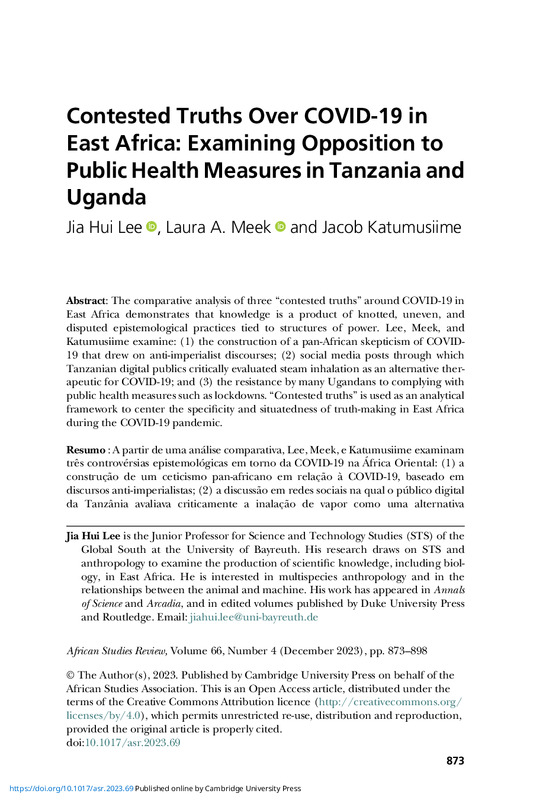
Contested Truths Over COVID-19 in East Africa : Examining Opposition to Public Health Measures in Tanzania and Uganda
The comparative analysis of three “contested truths” around COVID-19 in East Africa demonstrates that knowledge is a product of knotted, uneven, and disputed epistemological practices tied to structures of power. Lee, Meek, and Katumusiime examine: (1) the construction of a pan-African skepticism of COVID-19 that drew on anti-imperialist discourses; (2) social media posts through which Tanzanian digital publics critically evaluated steam inhalation as an alternative therapeutic for COVID-19; and (3) the resistance by many Ugandans to complying with public health measures such as lockdowns. “Contested truths” is used as an analytical framework to center the specificity and situatedness of truth-making in East Africa during the COVID-19 pandemic.
COVID-19 and (Im)mobilities in West Africa
This study examines recent developments of mobility patterns in West Africa within the context of the ongoing COVID-19 pandemic. A broad understanding of mobilities is applied to account for mobilities of people, goods and capital likewise. The aim is to track changes in mobility patterns caused by the pandemic and by institutional responses to the latter. The study may herein serve to encourage more in depth and comprehensive studies of the new (im)mobilities and the regimes that shape them. Embedding the subject of mobility changes into the political-economic framework of the networks of global capitalism and taking a perspective on the formative regimes, we develop first suppositions on how to apply the concept of (im)mobility regimes to assess the newly manifested (im)mobilisations. To shed light on the bigger picture of recent developments in Western Africa, this study tackles a wide range of mobility-related topics. At first, the epidemiological situation as well as the local testing regimes are analysed in order to assess the extent to which the pandemic is scientifically captured in Western Africa in contrast to other regions. By then providing a systematic outline of the lockdown policies of the individual ECOWAS member states, a first approach to the formative regimes can be given. The manifest new (im)mobilities of people are then evaluated with a focus on public transport, migratory movements and public air travel. Thereafter, the (im)mobilities of goods are discussed with a special focus on maritime freight mobilities. Finally, (im)mobilities of capital are dealt with in order to address changes and constants in the context of COVID-19, for example in the realm of remittances. Overall, this provides a first basis for a multi-dimensional understanding of the emerging phenomena in the ECOWAS region.
Das Archiv als Heimat : Die ‚Fantasie Afrika’ des Kunstpatrons Ulli Beier und der Künstlerin Georgina Beier
In der vorliegenden Arbeit habe ich anhand von Bildannäherungen an zehn Fotografien aus dem Archiv des Kunstpatrons und Kunstsammlers Ulli Beier und seiner Frau, der Künstlerin Georgina Beier, die Suche und Verwirklichung dieses Paares nach einer Heimat, ihrer ‚Fantasie Afrika’, untersucht und aufgezeigt, wie sehr dieses Archiv hierbei als Projektionsfläche und Referenz diente, diesen Ort physisch und psychisch zu konkretisieren. Die Suche der Beiers verbindet ein nostalgischer Rückblick auf ein präkoloniales Afrika mit der aktiven Gestaltung einer ‚modernen’ künstlerischen Realität. Die in ihrem Archiv über die Jahre gewachsene, individuell konstruierte Heimat gab ihnen die Möglichkeit, diese auch an andere Orte ‚mitzunehmen’, dort erneut umzusetzen und somit zu ‚konservieren’. U. und G. Beier kamen 1950 und 1959 nach Nigeria zu einer Zeit, in der der Kulturpessimismus des 20. Jahrhunderts im Westen die Frage nach alternativen Lebensformen aufwarf. Afrika als Projektionsfläche für Fantasien und Sehnsüchte war deshalb auch für europäische Kunstpatroninnen und Kunstpatrone der Moderne eine reizvolle Möglichkeit, diese Sehnsüchte zu verwirklichen. Die Zeit, in der U. Beier und G. Beier als Kunstpatron und Kunstpatronin wirkten, war von den Unabhängigkeitsbestrebungen afrikanischer Staaten geprägt. Ihre Art von Kunstpatronage war also ein Zeitphänomen, die damals in verschiedenen Ländern Afrikas in ähnlicher Form ebenfalls von westlichen Einwanderern betrieben wurde. Diese kamen unter anderem auch deshalb nach Afrika – die Wahl des Landes erfolgte oft zufällig oder hatte koloniale Hintergründe –, um eine neue Heimat zu suchen, in der sie sich selbst neu erfinden und die sie (mit)gestalten konnten. Sie waren Kunstliebhaber, Architekten, Künstlerinnen und Künstler, Kunstlehrerinnen und Kunstlehrer, die unter anderem die in ihren Augen rigide akademische Kunstszene in Europa ablehnten. Sie reisten in verschiedene Länder Afrikas, wobei die Wahl des Landes oft zufällig erfolgte oder koloniale Hintergründe hatte, um eine neue Heimat zu finden, in der sie sich selbst neu erfinden und die sie (mit)gestalten konnten. Sie machten sich besonders durch ihre formelle und informelle Kunstvermittlung einen Namen und beteiligten sich aktiv am Aufbau kultureller Szenen in ihrer Wahlheimat. Ihre aktive Gestaltung vor Ort war geprägt von einem nostalgischen Blick auf ein in Europa konstruiertes Afrika und die Sehnsucht nach einem vom Westen unbeeinflussten Ort, der ihnen die Hoffnung gab, sich aus einem Nachkriegseuropa lösen und sich in einer ihnen fremden Umgebung neu positionieren zu können. Oft ging ein solcher Umzug mit einem Heimatverlust einher, der sie zwang, in den ihnen fremden Ländern eine neue Heimat mit all ihrer Vertrautheit und Sicherheit aufzubauen. Heimat als Ort der Zugehörigkeit und Vertrautheit ist eine geistige Zuordnung zu einer bestimmten Umwelt, die sich in einem sozialen Umfeld individuell äußert (Egger 2014) und ein Idealzustand, nach dessen Verwirklichung wir streben, der aber als utopischer Entwurf bestehen bleibt (Bloch 1977). Heimat kann sich, basierend auf dem Gefühl der Zugehörigkeit, aus Erinnerungen speisen, selbst wenn der Ort als physische Realität nicht mehr vorhanden ist (Bausinger 1990). Viele dieser Kunstpatrone hinterließen Archive, die als rhizomatische Anordnungen von Bildern verstanden werden können. Das gilt auch für die Beiers, die im Laufe der Jahre ein umfangreiches Archiv angelegt haben, das heute zumindest in Teilen der Öffentlichkeit zugänglich ist. Dieses Archiv umfasst materielle und mentale Bilder aus verschiedenen Ländern. Einige der materiellen Bilder sind bis heute im Privatbesitz geblieben, während der größte Teil öffentlich auf der Website der Universität Bayreuth zugänglich ist. Die Originale befinden sich seit 2020 in Osogbo bei dem CBCIU (Center of Black Culture and International Understanding). Topographischer Schwerpunkt ist Nigeria, genauer gesagt Oshogbo, der Ort, an dem vor allem Ulli Beier lange Zeit lebte. Das Archiv sowie meine Annäherungen an einige ausgewählte Bilder daraus belegen die Suche der Beiers nach einer Heimat, machen deutlich dass auch die Beiers ein codiertes Bild von Afrika hatten und zeigen, wie sehr dieses Bild – eine Mischung aus Realität und Fantasie, Selbstinszenierung und Nostalgie – mit der eigenen Person verbunden war. Sie wollten u. a. traditionale Bilder vor Ort bewahren andererseits aber auch eine neue Bildsprache fördern. Besonders in Workshops trafen sich Gruppen von akademisch ungeschulten Personen und kulturelle Außenseiter, z. B. Künstlerinnen oder Künstler aus Europa, um eine Zeit lang zusammenzuarbeiten und eigene Formen der Kommunikation zu entwickeln. Die Forderung nach aktiver Aneignung des kulturellen Umfelds ging einher mit der Suche nach einer Heimat, die sie vor Ort zu verwirklichen hofften. Ihre Suche glich in ihren Augen der Suche der lokalen Bevölkerung nach einer postkolonialen Identität und schien somit mit dieser einen schicksalhaften Verbund zu stiften. Der spezifische Zeitgeist und die Aneignung der Umgebung durch aktive Gestaltung führten bei den Beiers dazu, dass sie Nigeria, vor allem Oshogbo, als ihre Heimat betrachteten und besonders im Nachhinein, so in späteren Publikationen und Biographien, die oft in enger Zusammenarbeit mit ihnen geschrieben wurden, ihre schicksalhafte Verbundenheit mit dem Land und den Gemeinschaften vor Ort konstruierten. Hier entwickelten sie zudem Konzepte und Ideen, wie das des ‚modernen Künstlers’, die sie später auch an anderen Orten zu verwirklichen suchten. Meine Bildannäherungen zeigen aber nicht nur die Heimatsuche der Beiers, ihr Ankommen in der neuen Heimat, und ihr Bestreben die eigene Rolle und Bedeutung für sich und die Nachwelt festzuhalten, sondern auch ihre Codierungen – sich stetig ändernde Regeln und Zeichen, in und mit denen sich ein Mensch bewegt. Auch die aktive Gestaltung der Beier vor Ort war zunächst von einem nostalgischen Afrikabild geprägt und von der Sehnsucht geleitet, einen vom Westen unbeeinflussten Ort zu finden. Ich spreche von einer ,Fantasie Afrika’, die sich im Laufe der Zeit veränderte, einem schöpferischen Akt, der kreativ und zukunftsorientiert war und die in der Realität und im eigenen Bewusstsein verankert war. U. und G. Beier kamen mit einer codierten Wahrnehmung nach Nigeria, die besonders bei U. Beier geprägt war durch Diskurse in Europa (z. B. der Negritude). Einem Scheitern an ihrem Bild von Afrika begegneten sie, indem sie ihr Umfeld aktiv nach ihren eigenen Vorstellungen gestalteten. Dies geschah natürlich in Zusammenarbeit mit ganz unterschiedlichen menschlichen und nicht-menschlichen Akteuren, die wiederum ihre ‚Fantasie Afrika’ und damit ihre Codierungen maßgeblich beeinflussten und veränderten. Ausgangs- und Bezugspunkt meiner Arbeit war das Bild in seiner unterschiedlichen Materialität. Die damit verbundenen medialen Eigenschaften bestimmen, wie sich Material und Subjekt zueinander verhalten; diese sind für meine Bildannäherungen von zentraler Bedeutung. Ich habe den Begriff ‚Annäherung’ verwendet, da ich dadurch den Prozess verdeutlichen will, den ich während meiner Beschäftigung mit den Bildern durchlaufen habe, nämlich das Wahrnehmen der Bilder auf unterschiedlichen Ebenen, das näher Hinschauen, das Anfassen und auch das wieder Weglegen. Durch mein eigenes Arbeiten mit Bildern habe ich zudem die klassische Ikonologie erweitert, also die Beschreibung und Analyse eines Bildes mit dem Ziel, das Bild allumfassend zu begreifen. Das Archiv, und somit auch das Archiv der Beiers, ist eine Verdichtung von materiellen und mentalen Bildproduktionen, die sich rhizomatisch und je nach Wahrnehmung anders anordnen. Ihm liegen Codierungen zugrunde, die eine Wissens(an)ordnung rekonstruiert und fragmentarisch Geschichte wiedergibt. In einem Rhizom, eine nicht-hierarchische Form von Wissensanordnung, in der Verbindungen jederzeit aufgenommen und unterbrochen werden können, bilden sich Plateaus, also Verdichtungen von Codierungen, wie z. B. das Beier-Archiv und meine ausgewählten Bilder. Verschiebungen der Verbindungen, also das Auflösen von Plateaus, finden nebeneinander statt, Bilder verschwinden nicht, sondern existieren nebeneinander in einer anderen Anordnung, die sich jederzeit wieder ändern kann. Ich bin vor allem an den Codierungen der Beiers, an der Sichtbarkeit ihrer Diskurse und an dem emotionalen Unterbau ihres Archivs interessiert und versuche dies anhand von Fotografien, deren Auswahl wiederum meine eigenen Codierungen offenlegen, aufzuzeigen. Trotz meiner weitgefassten Bilddefinition habe ich mich auf Fotografien im Archiv beschränkt, die den codierten und fragmentarischen Blick von U. Beier, als Fotograf (G. Beier fotografierte nicht) wiedergeben. Die Fotografie als ‚Beweismittel’ der eigenen Existenz, der vermeintlich objektiven Dokumentation erscheint hier fotobiografisch. Zusammen mit Texten, Filmen, Dokumenten und weiteren Bildern im Archiv erzählen sie eine Lebensgeschichte, die im Falle der Beiers in weiten Teilen und vor allen Dingen im Nachhinein inszeniert wurde, die jedoch auch Einblicke geben, in eine weniger kontrollierte Heimatsuche und damit einer Suche nach einer Identität. In meinen Bildannäherungen erweitere ich die klassische Ikonologie und versuche, die Fotografien allumfassend, mit allen Sinnen wahrzunehmen. Dazu war es nicht nur notwendig das Archiv zu sichten, um die Bilder in einen Kontext einzuordnen, sondern auch Gespräche, Interviews und Bildbesprechungen mit G. Beier, mit Zeitgenossinnen und Zeitgenossen der Beiers sowie mit Kolleginnen und Kollegen zu führen. Dabei war oft das Material, also der Papierabzug, als haptisches und visuelles Erlebnis wichtig, denn es löste bei den Gesprächspartnerinnen und Gesprächspartnern Reaktionen aus und weckte Erinnerungen. Das gab mir die Möglichkeit, das Bild aus unterschiedlichen Sichtweisen zu betrachten und somit meine eigenen Codierungen zu hinterfragen.
Data for health system comparison and assessment in the African Region: A review of 63 indicators available in international databases
Background Achieving universal health coverage in the African region requires health systems strengthening. Assessing and comparing health systems contributes to this process, but requires internationally comparable data. The European Observatory on Health Systems and Policies has produced Health Systems in Transition (HiT) reviews in Europe, Asia, North America and the Caribbean with a standardised template. This study explores data availability in international databases for the quantitative health and health system indicators in the HiT template for the WHO African region. Methods We identified ten databases which contained data for 40 of the 80 original HiT indicators and an additional 23 proxy indicators to fill some gaps. We then assessed data availability for the resulting 63 indicators by country and time, i.e. first/last year of data, years of data available overall and since 2000, and we explored for each indicator (1) against the country with the greatest availability overall and (2) against annual availability for all years since 2000. Results Overall data availability was greatest in South Africa (93.0% of possible total points) and least in South Sudan (59.5%). Since 2000, Uganda (60.4%) has had the highest data availability and South Sudan (37.2%) the lowest. By topic, data availability was the highest for health financing (91.4%; median start/end date 2000/2019) and background characteristics (88.5%; 1990/2020) and was considerably lower for health system performance (54.5%; 2000/2018) and physical and human resources (4.8%; 2004/2013). Data are available for different years in different countries, and at irregular intervals, complicating time series analysis. No data are available for service provision indicators. Conclusions Gaps in data in international databases across time, countries, and topics undermine systematic health systems comparisons and assessments, regional health systems strengthening, and efforts to achieve universal health coverage. More efforts are needed to strengthen national data collection and management and integrate national data into international databases to support cross-country assessments, peer learning, and planning. In tandem, more research is needed to understand the specific historical, cultural, administrative, and technological determinants influencing country data availability, as well as the facilitators and barriers of data sharing between countries and international databases, and the potential of new technologies to increase timeliness of data.
Decolonial Aesthetics II : Modes of Relating
This book features writing by 17 authors from Germany and from African and Latin American countries on highly diverse aesthetic phenomena as seen from their own different points of view. The texts in this volume all deal with the imperative of ‘decolonization’: they try to highlight aesthetic strategies for the (re)discovery of unthematized, misappropriated, transcultural and even transcontinental histories and memories and aesthetic practices that are absent from or too little perceived within national consciousnesses. Novels, poems and musical performances from the East African region are analysed as intertwined histories of the Indian Ocean and its different languages. Artworks of the Black Atlantic and perceptions of Africa are discussed from, for example, Brazilian perspectives. Within the German context, decolonisation strategies in exhibition practices in ethnological or art museums developed by Nigerian artists are evaluated; new terms such as ‘dividuation’ are proposed to describe these contemporary composite-cultural entanglements, and so on. A stimulating, wide-ranging and heterogeneous portrait of contemporary interwoven world cultures!
Decolonisation of Higher Education in Africa : Perspectives from Hybrid Knowledge Production
This book discusses the status and importance of decolonisation and indigenous knowledge in academic research, teaching, and learning programmes and beyond. Taking practical lessons from a range of institutions in Africa, the book argues that that local and global sciences are culturally equal and capable of synergistic complementarity and then integrates the concept of hybrid science into discourses on decolonisation. The chapters argue for a cross-cultural dialogue between different epistemic traditions and the accommodation 'Indigenous' knowledge systems in higher education. Bringing together critical scholars, teaching and administrating academics from different disciplines, the chapters provide alternative conceptual outlooks and practical case-based perspectives towards decolonised study environments.
Decolonising education : An exploration in Bolivian-German relations
In this article I aim to contribute to a more multifaceted picture of what decolonising education can mean. I do this in the form of a case study of selected and intertwined Bolivian–German discourses and practices directed at the decolonisation of education in the wide sense of the term. First, I introduce Indigenist and ‘Indianist’ proposals, which are shaped, not least, by Nietzschean ideas. In a second step, I turn to some examples of German ‘Bildungsromane’ that are deeply entangled with Bolivian phenomena. Hence, the first part of the article is about decolonising the formerly colonised via education, whereas the second revolves around decolonising the former colonisers, but without the possibility for or the wish to identify completely clear-cut boundaries. It will thus become clearer how decolonising education can be understood as a relational phenomenon.
Decolonizing Knowledge : Starting Points, Consequences and Challenges
The call for the decolonization of knowledge refers to both its colonization and contingency and puts the focus on the multiplicity of knowledge. This contradicts European-North- American thinking and definitions of knowledge. Consequently, to advance an epistemological decolonization of knowledge, the actual process of defining knowledge will be analysed and the multiplicity of perspectives stressed at the epistemological level. Using Indian epistemology as an example, I will work out differences in definitions of knowledge and therefore basic diversifications in describing and explaining the emergence of knowledge. Truth-value-neutral forms of knowledge in particular challenge dominant European-North-American philosophical definitions, which incontrovertibly include assumptions of true or false knowledge. An interesting overlap between some Indian epistemologies and postcolonial theories can be observed with regards to the central role of the contextualization of knowledge production and the socially embodied nature of scientific knowledge in general. If the incentives gained are to be taken seriously, the consequences for educational science in general as well as educational practices must be discussed. According to the findings of organizational theory, emphasis on diversification and complication is also seen as an opportunity for the emergence of fresh meaning. Referring to Helen Verran’s concept of generative tension as a sign of collective creativity, encounters between diverse forms of knowledge and epistemological principles are seen as sources of creative processes and prerequisite for the emergence of new positions, perspectives etc., and thus as incubators for innovations.