

Publications
Origins & context
- Title
- Publications
Loading…
Loading…
Items
The Transatlantic Slave Trade and the Reimagination of Colombian Identity in the Poetry of Jorge Artel
The literary tradition of South America has generally been imagined and legitimized in terms of the continent’s Hispano-American cultural heritage, epistemologies, and genealogies. Amid this hegemonic tradition, Black and Indigenous cultural presences and creative imaginaries have been relegated in favor of Hispano-American worldviews. Artistic creations by these “other” subjects have long been considered secondary to the Creole/mestizo canons, and have thus not benefited from the same degree of critical attention and circulation in mainstream literary circles. However, the trend is gradually changing, at least with regard to Afro-Colombian literature, as new generations of creative voices have gradually gained space and interrogated the generally accepted paradigms of Colombian identity. In the same vein, works long shunned by critics and the reading public have been reevaluated and granted increased editorial attention, critical scrutiny, and legitimizing awards. Jorge Artel’s poetry reinscribes Black bodies, cultural symbols, epistemologies, and legacies of the transatlantic slave trade into Colombian national history. His poetry, which is inscribed within the negrista tradition, reexamines the Colombian Atlantic space, especially his home city of Cartagena de Indias, questioning entrenched cultures of marginalization. His collection, Tambores en la Noche (Drums in the Night), first published in 1940, can be considered a reimagination of that city’s memorial cartography in order to underline the vestiges of enslaved Africans and their continuous configuration of Colombian national identity
The Use of Social Media in Enacting Emotional Care to Elderly People During the Covid-19 Pandemic : Empirical Evidence from Rwanda
The paper examines the relevance of social media use by older people in their emotional care relationships with their kin living apart from them. Older people’s use of social media is still less visible in Rwanda and overlooked by researchers. The folk narrative in Rwanda considers social media usage a youth phenomenon. This paper goes beyond this consideration and shows how social media plays a significant role in care provision during crises like the COVID-19 pandemic. The research uses in-depth interviews of older people and their children to highlight social media’s usefulness in facilitating daily interactions. Since children could not travel to the village to visit their parents, social media allowed them to exchange with their older parents frequently calls and chats, which contained comforting words necessary for reducing the emotional stress created by the COVID-19 pandemic. Even if older people face the challenge of access to smartphones and digital literacy, using social media in enacting emotional care for older people proves to be indispensable in creating solid bonds, belongingness, and attachment to them.
The Worlds around Taiwo Shango
Introduction: This special issue is a first stepping stone towards the recuperation and reappraisal of the long-lost television film Taiwo Shango oder: Der zweite Tag nach dem Tod [Taiwo Shango or: The Second Day after the Death] (1965, dir. Klaus Stephan), a co-production by the Bayerischer Rundfunk (BR, Bavarian Broadcasting) and Westdeutscher Rundfunk Köln (WDR, West German Broadcasting Cologne) in conjunction with the Nigerian Television Service (NTS). It also draws attention to the extensive photographic legacy of Nina Fischer-Stephan (1922–2018), who documented life in Nigeria from the late 1950s to the mid-1960s, and whose work cannot be separated from the production of Taiwo Shango. Contributions emerged out of a joint Nigerian–German research collaboration between the universities of Lagos and Bayreuth (UniLag and UBT, July 2021–December 2022), which initially focused on close readings of the film in relation to contemporaneous and contemporary cultural production and cultural industries in Nigeria and Germany. Also included are the voices of scholars who usually do not study media and performance but share illuminating insights into the contexts of the film; and initial responses to the first outdoor installation of Fischer-Stephan’s pictures in Lagos in 2022. The Stephan and Fischer-Stephan estate is held at Iwalewahaus,University of Bayreuth, Germany, whose first director was Ulli Beier.
This is our water : The politics of locality and the commons in the city of Bulawayo
The city of Bulawayo has had water problems since its establishment. This is partly due to the semi-arid climate within which it is situated, but also to rising levels of demand that have not been met with adequate supply. There are many disagreements among various stakeholders around ownership and management of water infrastructure. Between 2005 and 2015, two waves of protests occurred that had a profound impact on citizen-state relations at both the national and local levels of government. The first wave, 2005–2008, was supported by local city authorities as well as residents. They directed their protest at the ruling government’s decision to effectively transfer the management and ownership of the city’s water resources to a central government agency, the Zimbabwe National Water Authority (ZINWA). The transfer to that agency was part of a national program supposedly meant to improve water provision in the country’s cities and towns. However, the residents of Bulawayo and other cities that were run by the opposition regarded this decision about a common good – water – as a paternalistic assault on their political autonomy. In the end, these protests were successful, and Bulawayo remained the only city in control of its water resources. A few years later, the second wave of protests, 2011–2015, took a different turn. This time, people directed their protest at the City of Bulawayo and its decision to privatize the common good by introducing prepaid water meters. Again, the city’s rationale for the intended changes in the water management system was, purportedly, to improve supply and access. Yet, the residents of Bulawayo fiercely rejected this intervention, this time framing their protests in the language of indignation and need. This chapter critically engages the shifting political subjectivities of protesters in relation to national and local authorities in Bulawayo. By rethinking the notion of water as a common good, it also critically engages the concept of the moral economy as a lens of interpreting the ways in which the citizens in Bulawayo perceive and engage with the state.
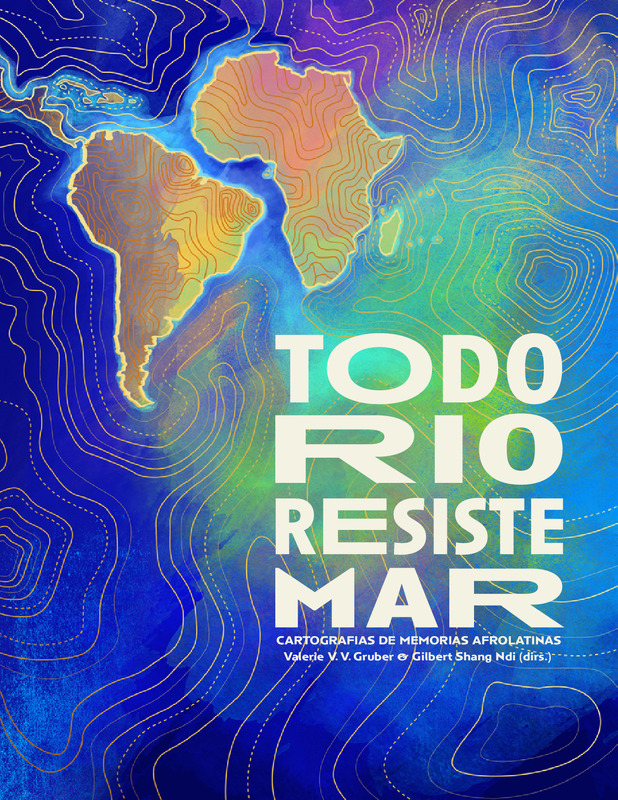
Todo Rio Resiste Mar : Cartografias de Memorias Afrolatinas
Essa viagem textual nos leva por caminhos de transformação corporal-emocional-espiritual que abrem horizontes para a imaginação criativa de artistas afrodescendentes da Colômbia e do Brasil. Por via de uma sinergia de meios artísticos como poesia, documentário, memórias, performances coreográficas e musicais, o/a leitor/a-espectador/a-ouvinte acompanha os movimentos dos corpos, as lembranças, os sonhos e as ilusões das pessoas enquanto elas meandram por territórios geográficos complexos onde enfrentam novas correntes, ganham impulso, ocasionalmente são ameaçadas de dissolver-se indefinidamente, apenas para ressurgir, adquirir novas tonalidades e florescer. A coleção é produto de uma pesquisa-ação participativa que explora e experimenta modos de cocriação de conhecimentos, refletindo sobre a (re-)existência individual e coletiva por meio de práticas artísticas em comunidades periferizadas.
Towards a discursive history of the Caribbean as a history of genres
The investigation of text formats beyond literary genres has so far been the exception in research literature on World Englishes and English-related contact varieties (cf. Bhatia, 2006; Görlach, 2004; Mühleisen, 2022a). In this chapter I will briefly outline the discursive formation and development of Caribbean Englishes/Creoles in particular written and spoken text formats. By exploring genres such as recipes, letters to the editor, advice columns, radio phone-in programmes or internet forums, I argue, we acknowledge Caribbean creative adaptations and localized versions of highly conventionalized genres. My particular focus in reviewing the discursive history of Caribbean Englishes/Creoles as a history of genres lies on the contribution of the postcolonial context as well as on the significance of oral culture in both written and spoken formats. After a brief exploration of genre theory and its application to the framework of Caribbean Englishes/Creoles, this chapter will highlight linguistic and cultural features in three case studies in a specific Caribbean context: (i) The recipe in Trinidad, (ii) the radio phone-in programme in Trinidad and (iii) the internet forum in Trinidad.
Towards an Integrated and Contextualized Research Data Management at the Cluster of Excellence Africa Multiple
In large collaborative, transdisciplinary and potentially geographically distributed research projects, joint data management enables not only the collection of research artifacts; it also fosters discovery and generation of new knowledge in the form of previously invisible interconnections between data. At the same time, a successful system for Research Data Management (RDM) offers immediate benefits to individual researchers: it helps save time finding, sharing, or editing relevant data objects, and can help prevent data loss through centralized backups. Following generations of researchers might benefit from a smartly maintained data collection. Furthermore, funding bodies increasingly require a concept for RDM as part of a grant proposal. As such, a resilient concept for RDM should be considered part of good scientific practice. With these aspects in mind, we present the Digital Research Environment at the Cluster of Excellence Africa Multiple and outline how it can foster best practices for data collection and discovery. Specifically, we introduce WissKI (Wissenschaftliche Kommunikationsinfrastruktur, “scientific communicationinfrastructure”), the system where research data is collected and new interconnections between data items can be determined programmatically.
Towards Transcultural Self-Writing : Mapping the Struggles of Minoritised Cultures in Colombia
More explicitly than in most other countries, the case of Colombia reveals that for members of minoritised groups such as Afrodescendant and indigenous communities, transculturality can be both a mobilising vision of hope and resistance, and a traumatising experience of colonisation and marginalisation. Against this backdrop, our chapter focuses on self-writing as a means of exploring the historical and ethical preconditions for a jointly envisioned transculturality, which are often overlooked in neoliberal discourses of a globalised world. Based on ethnographic experiences and self-writing research from Colombia, we examine how memory, corporality and territoriality constitute avenues of transcultural imagination. We argue that transculturality needs to be rooted in a critical consciousness of historical processes of colonisation, collective trauma and persistently unequal power relations. For peoples of formerly colonised spaces, rewriting the self is a matter of urgency and agency. It is the basis for the (re)negotiation of their existence, interaction and exchange with other cultures.
Traces of socialism in Burkina Faso's party system : the trajectory of Sankarism in times of political liberalization
The leftist traces of Thomas Sankara, Africa’s Che, in Burkina Faso and beyond is undeniable. The recent insurgency that overthrew Blaise Compaoré and his long-standing government framed itself as a second revolution, referring extensively to Sankara, whose image proved to mobilize many young protesters. Political parties that identify as Sankarist have opposed Compaoré over decades and managed not to fade away despite the increasing temporal distance from the first revolution led by Sankara between 1983 and 1987. This contribution argues that Sankarism survived in Burkina Faso’s party system because partial political liberalization allowed Sankarist politicians to compete against Compaoré, and because Sankarism adapted to a changing institutional environment and turned away from socialism to become social democratic by trend. In other words, contingently emerging pockets of liberal democracy have let Sankarism survive.
Trade agreements and subnational income of border regions
Abstract This paper analyses the differential effect of trade agreements on income per capita of subnational regions with international borders. We construct an extensive panel dataset covering 1350 regions in 86 countries worldwide between 1950 and 2017. Our results show that trade agreements are positively associated with income per capita of regions sharing contiguous borders with trading partners, relative to regions sharing borders with countries with whom no trade agreements exist. For border regions, the positive relationship of trade agreements and regional income roughly compensates potential income disadvantages of having international borders. These insights help in explaining and mitigating regional inequalities.
Transdisciplinary Connections : Afro-Latin America meets Bayreuth
After two years of virtual collaboration on questions of the African diasporas, three Latin American research partners of the Cluster project Moral Geographies of Re-Existence visited Bayreuth in 2021: Rigoberto Banguero Velasco, Laís Machado, and Diego Araúja. Their guest stays set the project’s transdisciplinary knowledge production afloat.
Tricky Violence : Vigilantism as a Moral Experiment in Urban Burkina Faso
Most research on vigilantism in the social sciences assumes that vigilante groups in Africa operate on the basis of a homogenous moral order. Based on a rare opportunity to conduct ethnographic fieldwork with Koglweogo vigilante groups in urban Burkina Faso, I argue instead that vigilantism is an experimental moral project that struggles with the question of how to exercise violence in a “good” way. Drawing on recent debates in moral anthropology, I investigate the personal dilemmas and moral conflicts that emerge among Koglweogo members, as well as the transformative potential of their violent interventions. This in-depth look at the ordinary moral practices of vigilantes reveals that the morality of vigilante violence is contingent and highly negotiated, and this perspective complicates our understanding of violence where it appears to be collective.
Trust, and distrust, of Ebola Treatment Centers : A case-study from Sierra Leone
The paper considers local responses to the introduction of an Ebola Treatment Centre in eastern Sierra Leone during the West African epidemic of 2014–15. Our study used qualitative methods consisting of focus groups and interviews, to gather responses from patients, members of the families of survivors and deceased victims of the disease, social liaison workers from the centre, and members of the general public. The data indicate that scepticism and resistance were widespread at the outset, but that misconceptions were replaced, in the minds of those directly affected by the disease, by more positive later assessments. Social workers, and social contacts of families with workers in the centre, helped reshape these perceptions, but a major factor was direct experience of the disease. This is apparent in the positive endorsements by survivors and families who had members taken to the facility. Even relatives of deceased victims agreed that the case-handling centre was valuable. However, we also present evidence of continuing scepticism in the minds of members of the general public, who continue to suspect that Ebola was a crisis manufactured for external benefit. Our conclusions stress the importance of better connectivity between communities and Ebola facilities to facilitate experiential learning. There is also a need to address the wider cognitive shock caused by a well-funded Ebola health initiative arriving in communities with a long history of inadequate health care. Restoring trust in medicine requires Ebola Virus Disease to be recontextualized within a broader framework of concern for the health of all citizens.
Turkish Islamic Actors in Africa : the Case Study of Hayrat Vakfi in Niger
In the last two decades, Turkish Islamic movements have extended their influence to Niger, a predominantly Muslim state. Diverse Turkish Islamic movements, such as the Nur Cemaati, Süleymancı Cemaati, and Erenköy Cemaati, are actively engaging in Islamic education through Qur'anic schools and education centers in Niger. This paper, specifically, delves into the activities of the Hayrat Vakfi (Hayrat Foundation), a branch of the Nur Cemaati (Nur movement). The central thesis of this paper asserts that the presence of Turkish Islamic actors has initiated a "silent transformation" within Niger's Islamic landscape. To comprehend this phenomenon, the paper addresses three key inquiries: (a) The internal socio-political and economic dynamics of Turkey that drove Turkish Islamic movements toward internationalization, (b) The expansion strategies employed by Hayrat Vakfi for the dissemination of its Islamic teachings, and (c) The implications of its presence in the transformation of Niger's Islamic landscape. Methodologically, this research employs a single case study approach with ethnographic and historical analysis. Existing scholarship on Turkish actors in Africa has predominantly focused on topics such as humanitarian aid, trade, and diplomacy. Therefore, this study aims to expand the scope of scholarly exploration to encompass other dimensions of Turkish presence in the African continent.
Une étude comparative des discours sur le Covid-19 en Côte d'Ivoire et au Cameroun beaucoup de peur et de questionnement
This paper presents the first results of a research project that focuses on the moral dimension of health discourse. With the emergence of Covid-19 in early 2020, we focused on the communication accompanying the evolution of the pandemic in two French-speaking African countries: Cameroon and Côte d'Ivoire. Based on data consisting of interviews, focus group discussions and media discourses collected on site between May and November 2020, our article studies the imaginary of the new disease from its discursive construction. It is based on the hypothesis that, firstly, the discourse on Covid-19 is grafted onto an imaginary that already exists in the collective consciousness by reactivating elements of a previous epi- or pandemic discourse and, secondly, that this discourse has a strong moral content. We focused on the issue of vaccines, which were still in the development phase at the time, as they were at the centre of many controversies and often provoked highly moral reactions. Using a pragmatic-discursive approach that employs qualitative analyses, we examined how Ivorians and Cameroonians position themselves in relation to what is right and wrong and how they make moral judgements about the actions and behaviour of others. This pilot study shows that the discursive practices observed in the different formats collected in the two countries are very similar. Moreover, the cross-sectional views on Côte d'Ivoire and Cameroon, as well as the comparison with other pandemic discourses, enhance both a relational and multiple perspective while contributing to the question of how Africa lives and perceives this health crisis triggered by the outbreak of the coronavirus.
Unearthing Silent Data : Back to Basics in Process Design
We live in technology-driven societies, especially shaped by Artificial Intelligence (AI). The performance of AI models depends heavily on data quality—particularly the issue of data bias. Among the many sources of bias, one critical yet often overlooked type is silent data. This typically originates fromo rganizations with low digital maturity, which face challenges in effectively utilizing their data for operations and decision-making. These difficulties begin at the foundational level—data collection and data quality maintenance—hindering their ability to achieve strategic goals. In this work, we proposed comprehensive protocols for the management of the research projects and related administrative operations with a focus on data collection into two databases and on enhancing data quality. We also developed a strategy of maintaining data quality with limited resources, addressing the challenges posed by diverse and scattered data sources.
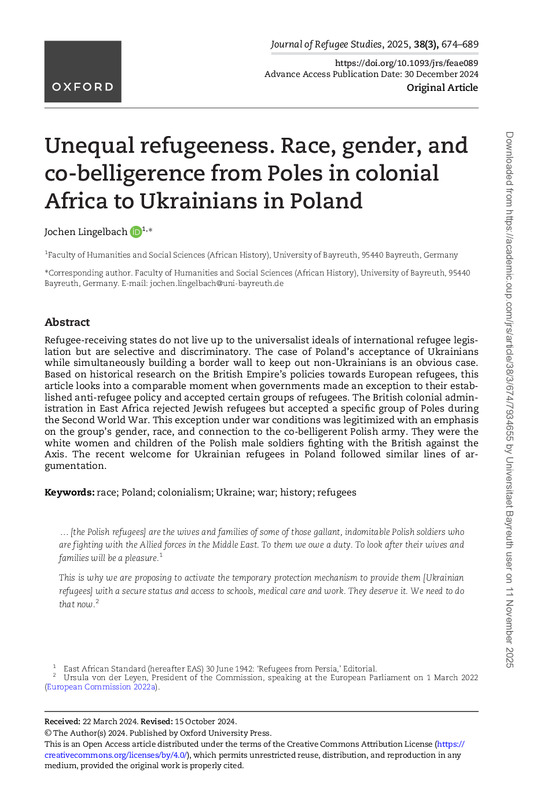
Unequal refugeeness : Race, gender, and co-belligerence from Poles in colonial Africa to Ukrainians in Poland
Refugee-receiving states do not live up to the universalist ideals of international refugee legislation but are selective and discriminatory. The case of Poland’s acceptance of Ukrainians while simultaneously building a border wall to keep out non-Ukrainians is an obvious case. Based on historical research on the British Empire’s policies towards European refugees, this article looks into a comparable moment when governments made an exception to their established anti-refugee policy and accepted certain groups of refugees. The British colonial administration in East Africa rejected Jewish refugees but accepted a specific group of Poles during the Second World War. This exception under war conditions was legitimized with an emphasis on the group’s gender, race, and connection to the co-belligerent Polish army. They were the white women and children of the Polish male soldiers fighting with the British against the Axis. The recent welcome for Ukrainian refugees in Poland followed similar lines of argumentation.