

Publications
Origins & context
- Title
- Publications
Loading…
Loading…
Items
The Debate - why economists get Africa (really) wrong.
In a debate on radical political economy, economics and economists working on Africa, Franklin Obeng-Odoom and Morten Jerven look at the use of statistics, mainstream economics, power, imperialism, patriarchy, and structural inequality. Both think that mainstream economists get much wrong about Africa, but they differ considerably in their diagnosis of the problem and the way forward.
The Education Alibi : Tracing Education's Entanglements Across Contemporary Africa
Education is generally promoted as the key to the future of Africa in global development discourses about the continent. Education's official story in Africa continues to be one of innocence and public good, yet, since colonial times, education has constituted an area of intense contestation. The Education Alibi asks if it is possible that while claiming to be doing one thing, education has also been doing another in African communities. The concept of the "alibi" shines an interrogative light on institutions' and actors' use of education to divert scrutiny from other effects. Through ethnographic research and critical analysis across the continent, this volume focuses on people's lived experiences to demonstrate how contemporary education systems in fact deepen economic, racialized, gendered, urban-rural, linguistic, religious, and other intranational and international inequalities.
The emergence of innovations through the encounter of knowledges in "the local" : How fresh action emerges in networks
In the contribution, first the concept of development and its interrelations with education is critically discussed. This leads to reflexions on the dysfunctionality of these educational concepts in certain so called non-western contexts in the majority world (also called global south). Instead of following the concept of development, the conditions, under which creativity and innovations can emerge in local contexts, are discussed from a network theory or relational perspective. As a basis, the emergence of knowledge in general is explained shortly, including also in line with the interest of the special issue in locality thoughts on indigenous knowledge. This approach is bringing together thoughts on localities, networks, and the emergence of knowledge with perspectives on conditions of possibilities for the emergence of innovations and creativity. I am using tools from the network theory to describe and analyse these relations and processes in detail. For the analysis, I will use an example from a Nigerian classroom.
The hidden side of local self-organisation and self-regulation : Elements for the comparative analysis of the constitution of self-organised groups
The notions self-organisation and self-regulation are at least implicitly loaded with a positive democratic connotation. The main corresponding debates on social move-ments, governance and civil society mostly refer to the Global North with a well-func-tioning state and democratic political systems. One consequence is that the less dem-ocratic and less liberal hidden side of self-organisation, seen by some critics, does not gain much attention. After a short discussion of the main theoretical approaches, the paper presents a se-lection of self-organised groups depicting their different values, norms, and structural features. These examples reach from democratic groups marked by solidarity to racist violent groups that are a threat to differently minded people. The analysis of these examples leads to a set of criteria for the comparative analysis of the internal structure of self-organised groups including potential membership, in- and outward orienta-tion, underlying basic principles of social order and types of trust with related types of decision-making. These basic elements help to understand the constitution and functioning of self-organisation, which are open to a wide range of value orientation.
The impact of COVID‑19 on health service utilization in sub‑Saharan Africa : a scoping review
Despite comparatively low rates of COVID-19 admissions and recorded deaths in sub-Saharan Africa (SSA), the pandemic still had significant impact on health service utilization (HSU). The aim of this scoping review is to synthesize the available evidence of HSU in SSA during the pandemic, focusing on types of studies, changes in HSU compared with the pre-pandemic period, and changes among specific patient groups. Methods The scoping review was guided by the methodological framework for conducting scoping reviews developed by Arksey and O’Malley. We identified relevant studies through a search of PubMed (MEDLINE), Embase, Scopus, and Web of Science. We then provided a general descriptive overview of the extracted data focusing on the types of studies, patient groups, and change in HSU. Results We identified 262 studies reporting on HSU in 39 SSA countries. Studies were mainly quantitative (192; 73.3%), involving multiple centers (163; 62.2%), conducted in hospitals (205; 78.2%), and in urban settings (121; 46.2%). The median number of participants was 836.5 (IQR: 101.5–5897) involving 62.5% females. Most studies (92; 35.1%) focused on communicable diseases and mainly among outpatients (90; 34.2%). Maternal and child health studies formed the largest patient group (58; 22.1%) followed by people living with HIV (32; 12.2%). Change in HSU was reported in 249 (95.0%) studies with 221 (84.4%) studies reporting a decrease in HSU. The median decrease in HSU was 35.6% (IQR: 19.0–55.8) and median increase was 16.2% (IQR: 9.1–31.9). The patient group with the largest percentage decrease was cardiovascular diseases (68.0%; IQR: 16.7–71.1) and the lowest percentage decrease was in patients with infections (27.0%; IQR: 16.6–45.6). Conclusions A large body of literature is available on the effects of the pandemic on HSU in SSA. Most studies report decreases in HSU during the pandemic. However, patterns differ widely across disease categories, patient groups, and during different time periods of the pandemic.
The impact of sea bottom effects on the retrieval of water constituent concentrations from multispectral satellite images in complex shallow tidal waters supported by radiative transfer modeling
Many coastal waters include large areas of Optically Shallow Waters (OSWs) where the sea-bottom affects above-water observations of remote sensing reflectance (Rrs [sr−1]). If not treated, the effect of bottom reflectance will interfere with the correct retrieval of Water Constituent Concentrations (WCCs) from hyperspectral and multispectral remote sensing observations. To study this phenomenon in more detail, the existing semi-infinite 2SeaColour Radiative Transfer (RT) model was modified into a finite water layer model, bounded by a diffusely reflecting surface at the sea-bottom. From simulations with the new model, called Water - Sea Bottom (WSB) model, it was observed that a ratio of spectral bands in the Near-Infrared, bands 750 nm and 900 nm, is nearly insensitive to the WCCs and increases with the shallowness of the water, and therefore can be used as a robust index to detect OSWs. The newly established Near-Infrared Bottom Effect Index (NIBEI) was applied to a series of satellite observations over the Wadden Sea during high and low tidal phases. Images from the MEdium Resolution Imaging Spectrometer (MERIS) and the Ocean and Land Colour Instrument (OLCI) were processed to retrieve WCCs of the study area. The results indicate that the sea-bottom effect in OSWs affects the accuracy of atmospheric correction and retrievals. On the other hand, applying the NIBEI to flag OSWs improves the reliability and consistency of WCCs maps. The application of proposed NIBEI on satellite images requires only Top Of Atmosphere (TOA) radiances at 750 nm and 900 nm and does not depend on atmospheric correction and ancillary local input data (e.g., bathymetry map, bottom type, empirical coefficients, in-situ measurements). As a result, the proposed NIBEI can readily be applied to detect OSWs on various ocean colour remote sensors in various shallow coastal regions.
The Intimate Link Between Income Levels and Life Expectancy : Global Evidence from 213 Years
Objectives What is the main driver of life expectancy across societies and over time? This study aims to document a systematic and quantitatively sizeable relationship between income levels and life expectancy. Method A panel data set of 197 countries over 213 years is analyzed with different regression methods. Robustness tests are provided. Results By itself, GDP per capita explains more than 64 percent of the variation in life expectancy. The Preston curve prevails even when accounting for country- and time-fixed effects, country-specific time trends, and alternative explanatory variables such as health-care expenditure, malaria prevalence, or political institutions. If anything, this link has become stronger over recent decades when data quality has improved. Results from instrumental variable estimations suggest this finding to be largely unaffected by reverse causality. Quantile regression results suggest the relationship between income and life expectancy to be persistent across different levels of life expectancy. Conclusion Income matters for life expectancy. If policymakers want to prolong people's lives, economic growth appears to be the predominant medicine.
The material politics of labour in Africa : A commentary
In this commentary, I offer a sympathetic critique of the special issue, ‘Under Construction: Towards Critical Perspectives on Infrastructuring and Infrastructured Labour in Africa’. I highlight the importance of systems of provisioning, deeper theorising of the accumulation dynamics surrounding large-scale infrastructure projects, clearer distinctions between work and labour, and excavating the links between visible and hidden labour in various economic sectors, as key areas for future research that I hope will be inspired by this special issue.
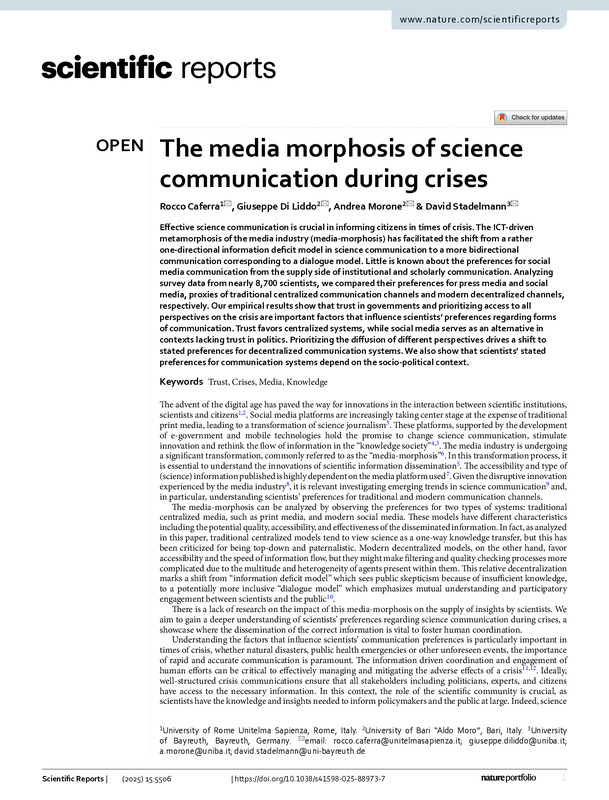
The media morphosis of science communication during crises
Effective science communication is crucial in informing citizens in times of crisis. The ICT-driven metamorphosis of the media industry (media-morphosis) has facilitated the shift from a rather one-directional information deficit model in science communication to a more bidirectional communication corresponding to a dialogue model. Little is known about the preferences for social media communication from the supply side of institutional and scholarly communication. Analyzing survey data from nearly 8,700 scientists, we compared their preferences for press media and social media, proxies of traditional centralized communication channels and modern decentralized channels, respectively. Our empirical results show that trust in governments and prioritizing access to all perspectives on the crisis are important factors that influence scientists’ preferences regarding forms of communication. Trust favors centralized systems, while social media serves as an alternative in contexts lacking trust in politics. Prioritizing the diffusion of different perspectives drives a shift to stated preferences for decentralized communication systems. We also show that scientists’ stated preferences for communication systems depend on the socio-political context.
The Memory Process in the Commemorations of the Dead in West African Newspapers
This chapter considers the memoryprocess in the commemorations ofthe dead inasample of newspapers from Nigeria and Liberia from the 1940s to1960s.At its centreare the obituaries and in-memoriams of middle-toupper-class citizens published by familymembers and the state. The chapter homesin on howanumber of journalisticprocesses, from“signalling”to“masking”to“controlling,”wereusedto capturespecific elements of the past and,moresignificantly, to guide the present and futureself-fashioning of the African elite.
The multiple meanings and uses of South–South relations in extraction : The Brazilian mining company Vale in Mozambique
South-South relations have raised hopes of a new development geography – one based on solidarity and more horizontal partnerships among countries in the Global South. In recent years, however, many of these aspirations have proven far-fetched. In the case of Brazil, the presidency of Jair Bolsonaro may even suggest that the South–South hype is now over and done. However, empirical accounts of the engagement of Southern, emerging market-based multinationals across the Global South, such as that of Brazil’s mining corporation Vale in Mozambique, remain scarce. One missing perspective in defining South-South relations is the agency of other actors beyond emerging powers’ governments. This article therefore goes beyond the pre-eminence of the Brazilian state. Instead, it analyses how South–South relations have been signified and used by two critical actors in the context of Vale’s extractive operations in Mozambique: first, the professionals involved in corporate responsibility projects and second, the Mozambican power elites. There is a range of analyses of South–South ties, the imaginaries and hopes associated with them, and their practical possibilities which change according to the expectations, demands, and interests of different actors. We observe that Brazilian professionals in particular have built on specific cultural framings and imaginaries associated with South–South relations to claim a distinct vision and practice of corporate responsibility. Taking note of the prominent role played by Mozambique’s ruling party Frelimo, we further demonstrate how Mozambican power elites have harnessed, through gatekeeping practices, the country’s commodity-spurred architecture of South–South relations to reaffirm political power and amplify individual economic interests. In light of Vale’s current withdrawal from Mozambique, we posit that our analysis provides a timely opportunity to reflect on the multiple makings, and implications of South-South engagement, the controversies linked to the role of Brazilian capital in Africa, and Mozambique’s development through extraction.
The personal is still political : Sexual orientation, gender identity and the politics of law making in Africa
This chapter critically examines the politicisation of sexual orientation and gender identity (SOGIE) rights in Africa. It highlights how anachronistic, colonial-era sodomy laws have evolved into a second wave of harsh anti-homosexuality legislation. Despite growing international recognition of SOGIE rights as fundamental human rights, many African states have intensified efforts to criminalise queerness under the guise of protecting morality, family values, and national identity. The chapter analyses the legal, political and sociocultural dynamics that sustain this trend, with a particular focus on Uganda, Nigeria and Ghana, whose laws serve as case studies of widespread legalised repression. These laws not only criminalise samesex acts and relationships but also ban advocacy, restrict freedom of association, and impose surveillance obligations on citizens. The proliferation of such laws is rooted in a complex interplay of factors, including colonial legacies, religious fundamentalism, and the instrumentalisation of queerness as a symbol of resistance to Western influence. The chapter also addresses the role of institutions such as the church and state in perpetuating discrimination and violence, often with impunity. It contrasts these regressive trends with progressive developments in jurisdictions such as Namibia, South Africa and Botswana, where courts have moved to protect SOGIE rights despite significant push-back. Drawing from feminist theory – particularly the notion that ‘the personal is political’ – the chapter reframes the oppression of queer Africans as a political crisis rather than a private issue of morality. It concludes by advocating collective action and regional solidarity to challenge the legal and cultural systems that dehumanise queer identities. By doing so, the chapter situates SOGIE rights within the broader fight for human dignity, equality and decolonisation in Africa, insisting that meaningful change requires confronting the political roots of exclusion and affirming the humanity of all individuals, regardless of their identity.
The Politics of Historical Memory and Commemoration in Africa : Essays in Honour of Jan-Georg Deutsch
The volume observes some of the principles that drove Prof. Jan-Georg Deutsch's research: highlighting present-day politics for the way they shape historical remembrance, learning from people on the ground through fieldwork and oral history, and bringing various parts of the African continent into discussion with one another. From Cape Town to Charlottesville, many societies are grappling with historical consciousness and the production of public memory. In particular, how and why societies remember and forget, what should serve as symbols of collective memory, and whether there exists space for multiple memory cultures are questions being vigorously debated once again. These discussions present particular challenges not only to official memory bound to ideological constructions of nationhood but also to the teaching of history and its links to social justice movements. The volume re-centres Africa and African history in memory studies, with each chapter drawing parallels to comparable cases in Africa and the world. An underlying assumption is that what can be learned from the politics of historical memory in Africa will have relevance for contemporary politics globally and for understanding how memories can be mobilised for political ends.
The Politics of Making Kinship : Historical and Anthropological Perspectives
The long tradition of Western political thought included kinship in models of public order, but the social sciences excised it from theories of the state, public sphere, and democratic order. Kinship has, however, neither completely disappeared from the political cultures of the West nor played the determining social and political role ascribed to it elsewhere. Exploring the issues that arise once the divide between kinship and politics is no longer taken for granted, The Politics of Making Kinship demonstrates how political processes have shaped concepts of kinship over time and, conversely, how political projects have been shaped by specific understandings, idioms and uses of kinship. Taking vantage points from the post-Roman era to early modernity, and from colonial imperialism to the fall of the Berlin Wall and beyond this international set of scholars place kinship centerstage and reintegrate it with political theory.