

Publications
Origins & context
- Title
- Publications
Items
'Ardent sympathetic constellations' : Conceptualising Astropoetics and Cosmopoetics in the Twentieth-Century Novel
This essay introduces the concepts of astropoetics and cosmopoetics to describe literary manifestations of astroculture in the twentieth-century novel. It suggests that astropoetic texts are media of astroculture, bringing their formal conventions and traditions to bear on the particular questions raised by attempts to instil outer space with human meaning. For the student of literary history, astropoetics thus offers a specific window onto the history of poetics and criticism. Drawing on the history of metaphors and Hans Blumenberg’s metaphorology, the essay explores how these concepts illuminate the novel genre’s epistemology, ontology, and anthropology. By tracing the interplay between cosmic order and literary meaning, it argues that astropoetics and cosmopoetics offer a framework for understanding the novel’s potential for producing knowledge, its nature as ‘real’ or ‘imagined’, and its function as a medium of expression. The essay concludes by examining the ‘Ithaca’ chapter from James Joyce’s Ulysses as a key modernist text that exemplifies the self-reflexive potential of cosmopoetics in the novel.
"Africapitalism" and the limits of any variant of capitalism
In a contribution to ROAPE’s debate on capitalism in Africa, Stefan Ouma provides a critical account of Africapitalism as well as an assessment of the future/s it imagines, what it silences and its potential to transform African economies. Ouma concludes that the ecologically destructive and dehumanizing architecture of our global economic system provides further evidence to condemn any variant of capitalism.
"Le petit Mahorais apprend à écrire de droite à gauche à l’école coranique. Ensuite de gauche à droite avec l’alphabet Latin" : Entretien avec l’écrivain mahorais Nassur Attoumani
Auteur-Acteur-Compositeur-Dramaturge-Fondateur de maison de culture-Ancien Dj de bals poussière, Nassur Attoumani, le porteur de multiples casquettes fidèle à son casque colonial est l’une des voix artistiques les plus importantes de l’archipel des Comores. Dans cet entretien Nassur Attoumani parle des langues d’écriture et des identités littéraires, des réseaux littéraires, de l’écrivain « postcolonial » comme traducteur (in)conscient, du lectorat absent, de la crise humanitaire liée à la « migration » des îles d’Anjouan, de Mohéli et de la Grande-Comore vers Mayotte et du mythe du casque colonial qu’il porte fièrement depuis plusieurs décennies.
"Practical recognition" as a suitable pathway for researching just energy futures : Seeing like a "modern" electricity user in Ghana
Governmental and non-governmental actors promoting the universalisation of energy access and a just energy distribution for all envision spatial energy justice and recognition. Yet how and the extent to which these considerations offer practical solutions to the energy needs and visions of different social groups simultaneously is less evident. This is particularly crucial in Ghana where a just, ‘state-driven’ electricity provision connotes recognition of privileges of citizenship and an aura of ‘modernity’. Many urban households in Ghana are keenly installing Solar Home Systems (SHS) to mitigate frequent grid power outages and ensure stability in the performance of social and energy-saving practices which grant them recognition as ‘enlightened’ social groups or as individuals staying au courant with modern energy technologies. Also, the Ghanaian government recently attempted to achieve spatial energy justice by providing free 500 W SHS to non-electrified, ‘territorially remote’ communities. Many community residents, however, claim the SHS facility restricts performances of ‘modern’ practices in comparison to fellow ‘Ghanaians’ who have access to electrical grids and that its acceptance may perpetually reduce them to ‘second-class’/‘old-fashioned citizens’. Our empirical evidence suggests that energy justice visions remain fuzzy unless they are set in relation to how and why practical solutions to the energy ‘needs’ and ‘visions’ of socially and spatially differentiated groups could be realised. We call this practical recognition. In this paper, we advocate practical recognition as a suitable alternative pathway for researching just energy futures by emphasizing connections between justice, human agency and entitlement notions.
"Social media is for the elite" : Local political communication in Ghana in times of COVID-19
With the spread of smartphones in Africa, social media applications particularly WhatsApp, Facebook and Twitter offer due to their commentary function a platform for political debate but also for political communication. We ask whether and how local administrations use this communication channel. We draw on our study of social media platforms in three selected districts in Ghana and examine the contents of local political discussions on these platforms. Although the topics of debate often vary according to local contexts, the outbreak of the COVID-19 pandemic presents crosscutting concerns that affect both urban and rural districts. We analyse topical issues communicated on the platforms as well as how local people react to those topics. Insights from earlier fieldwork and recent interview data allow us to compare the congruence between the topics of social media debates with the everyday contents of local political debates. We conclude with observations and hints on the methodological challenges of online research.
"They're plotting against us": Public narratives utilised by Kenyan Community-Based Organisations advocating for land rights
The narratives of Community-Based Organisations (CBOs) are significant for linguistic analysis as they provide natural data in highly emotional public discourses. In Kenya, any topic or discourse on land injustice is a highly emotive venture. In the same vein, public narratives are relevant to provide evidence for evaluations of language choice, power, and authority, as well as the linguistic communication of emotion. In this respect, emotion-provoking narratives are highly important phenomena that are hardly ever absent in the public discourse of CBOs advocating for land rights. Within the framing rhetoric of social movements, we explore how these groups frame land injustices within emotion-provoking narratives in public discourse. The methodology in this study involved audio-recorded data collected from two CBOs that represent land injustices due to government and/or company-propelled projects in Kenya: Tugen Hills Forests Right Holders and Kerio Valley Professionals Association based in Kabarnet town in Baringo county. Significantly, Kerio Valley Professionals Association advocates for land rights for communities along the border of Baringo county and Elgeyo-Marakwet county. The analysis reveals the following frames within narratives in the discourse of Kenyan CBOs addressing land injustices: victim, good vs evil, bad governance, and insecurity of tenure as strategic negotiation characters that constitute a prerequisite for legitimisation and proper enactment of land laws. At the same time, these narrative frames are laden with emotions such as anger, frustration, despair, and fear. Therefore, this research sheds light on how CBOs navigate for land rights by use of frames within narratives, particularly in public discourse, to sanction their emotional expressions as positive for the movements in order to bring about resistance and change for the benefit of the community.
“Are they just for venting out?” : Exploring discourses on women-only Facebook Groups on television talk show programs in Egypt
In Egypt, many women have created various private Facebook groups for women only to support women. As exclusive spaces for women, these Facebook groups enabled women in Egypt to share their experiences and quickly became a source of awareness. Concurrently, their proliferation and popularity as spaces exclusively encompassing thousands of women have attracted extensive mass media coverage in Egypt, particularly from talk show programs. Accordingly, this article uses critical discourse analysis to explore the discourses on popular women-only Facebook groups in mainstream talk show programs in Egypt. Ten talk show program videos were analyzed to identify the discourses on these Facebook groups. The article displays conversations from four talk show program segments to showcase two prevalent and simultaneous discourses. The first discourse conveys a moral panic over these Facebook groups for enabling women to discuss problems on matters of the private sphere. Conversely, the second discourse conveys an embracement of Facebook group creators’ entrepreneurial practices manifested from their Facebook group. Subsequently, these two discourses are critically analyzed by drawing on literature on gendered dynamics of the private and public spheres in Egypt and postfeminism in connection with commercial media logic.
“Changing beyond Recognition”? : Reimagining the future of smallholder farming systems in the context of climate change
We use the case of Northern Tanzania to put empirical flesh on the idea of diverse economies. We advance the idea that smallholder production systems offer ontological and practical resources to envision and perform more viable African rural futures, potentially with important lessons for the rest of the world.
“Hanging out” with judicial and legal elites: Reflections on researching “up”
The challenges of researching “up” are widely acknowledged. Moreover, these hurdles are intensified for law and courts field investigators where the profession’s cherished virtues – protocol, hierarchy and decorum – hamper access to interviewees and could potentially be detrimental to rapport building for the researcher unfamiliar with courtroom formality. This paper draws on the author’s field experience to highlight the potential of the informal dimension of fieldwork – “hanging out” – in traversing some of the limits of researching legal and judicial elites. It teases out the complexities of studying judges as political actors and the peculiar circumstances of studying legal elites in close-knit circles. Through “hanging out” at relevant court events, strategically positioning oneself in social events and informally building rapport, the author gained access to spaces usually closed off to outsiders. By “hanging out” with judges, the author challenged her perceptions of absolute judicial fidelity to the law, interrogated their professed devotion to apoliticism and the experience humanised judges and helped her deal with her own discomfort with interviewing judges. The paper concludes by weighing the promises and limits of the informal approach to researching legal and judicial elites, pondering ethical considerations, the researcher’s positionality and the boundaries of continuous residence.
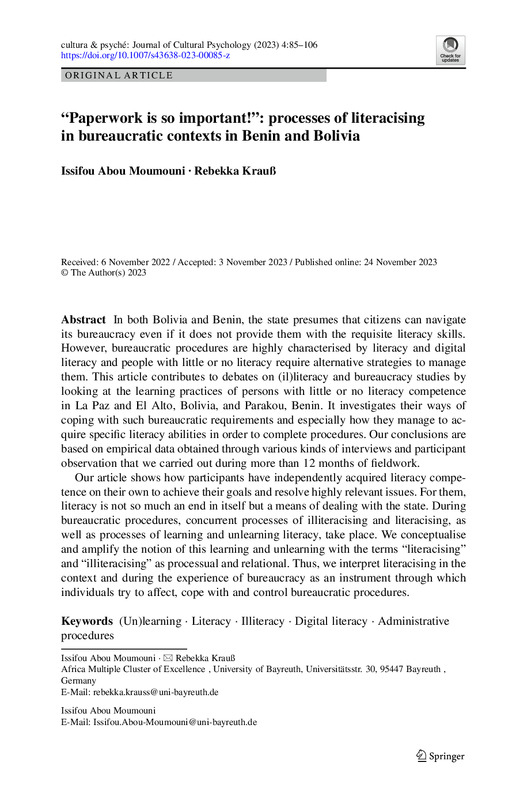
“Paperwork is so important!” : processes of literacising in bureaucratic contexts in Benin and Bolivia
In both Bolivia and Benin, the state presumes that citizens can navigate its bureaucracy even if it does not provide them with the requisite literacy skills. However, bureaucratic procedures are highly characterised by literacy and digital literacy and people with little or no literacy require alternative strategies to manage them. This article contributes to debates on (il)literacy and bureaucracy studies by looking at the learning practices of persons with little or no literacy competence in La Paz and El Alto, Bolivia, and Parakou, Benin. It investigates their ways of coping with such bureaucratic requirements and especially how they manage to acquire specific literacy abilities in order to complete procedures. Our conclusions are based on empirical data obtained through various kinds of interviews and participant observation that we carried out during more than 12 months of fieldwork.
“The Sea Cannot Be Spoken” : Thinking About Aesthetic Relations, the Poetics of Language(s) and Place Through Yvonne Owuor’s the Dragonfly Sea
The Dragonfly Sea by the Kenyan author Yvonne Adhiambo Owuor moves away from the West as the constant historical and geographical point of reference. This novel rewrites ancient and recent relations between East Africa and China (also Turkey) and puts an emphasis on far-reaching connections in the Indian Ocean. Rather than land, it is the shape-shifting, unsettling sea, larger than human life—its waves, surfs, currents, and scents, but also its pirates and container ships—which takes poetic center-stage in the novel. I start by exploring the ocean as a potent, productively opaque metaphor which defies stable representations, but underlines an aesthetic relationship to place and belonging. I argue, with reference to Glissant, that it safeguards relationships from assimilation into predefined and coercive discourses and also foregrounds a multitude of possible ways of knowing. Furthermore, the novel suggests a similar approach to language. A multitude of language and cultural repertoires figure—often untranslated and unexplained: Swahili proverbs, verses from taarab songs and children’s rhymes, Islamic formulas and calligraphy and Chinese pictograms disrupt the English narrative and challenge the reader. The novel foregrounds each language’s Eigensinn, but also, and even more so, the irreducible sensuous body of every language. With Emily Apter’s notion of ‘untranslatability’, I argue that ‘untranslation’ is a powerful act and meta-comment in the Dragonfly Sea, a novel that makes an effort not to ‘tame’ languages, treating them as easily substitutable. I demonstrate that productive moments of astonishment and discomfort arise in those parts of the text in which we hear, see and are made to ‘taste’, as the novel says, other languages and repertoires.
(Re)Visões de África no Cinema : Singularidades de Uma História Plural
Nos últimos anos, a história africana tem sido objeto de celebração e discussão, mas também disputas, em diferentes âmbitos – acadêmico, político, cultural. Particularmente, por meio do resgate e valorização do passado africano, tem-se buscado entender criticamente as contradições de seu presente e, a partir disso, formar alicerces que ajudem na edificação de um novo futuro para o continente. Um dos pilares desse processo de re-visão tem sido, reconhecidamente, as suas produções artísticas, e, em especial, a sua produção cinematográfica – considerada ao mesmo tempo como produto e produtora de Histórias. Dito isto, o artigo busca lançar luz sobre as continuidades e descontinuidades da produção audiovisual africana nas últimas décadas, a fim de entender como o continente africano e sua população têm sido imaginados e re-imaginados em diferentes momentos da história recente.
(Un)leashed potentials: an activist-centered perspective on the political mobilization of motorcycle taxi drivers in eastern DRC
The re-emergence of competitive elections in Africa has sparked new interest in political mobilization on the continent. Much of this literature focusses on political actors and the strategies they use to mobilize. If the campaign activists are reviewed at all, they are often categorized by their ethnic or religious affiliation. Thereby, abilities and potentials for political participation, which are important within conceptual literature on political mobilization, are side-lined. This article uses an activist-centered perspective to review the political mobilization of motorcycle taxi drivers, eastern Congo. Based on empirical research in 2020 and 2021, it evaluates the mobilization potentials of the so-called motards and their deployment during political action. The article finds that motards possess unique potentials for participating in political campaigns due to their mobility and large social networks but only partially deploy them. While their mobility potential is widely utilized, the mobilization of their social networks is hampered by a lack of allegiances and infrequent contacts with politicians. Based on the research findings, the article advocates expanding the perception of political mobilization in Africa by reflecting on the preconditions of mobilizability such as enabling potentials, interactions with activists and aligned political strategies.
A comparison of observed and perceived seasonal climate regimes in a rural socio-ecological system in the northeastern South Africa
This study investigated perceptions of climate change among residents of 12 villages in Bushbuckridge, Mpumalanga, South Africa, through household surveys and focus group discussions. These perceptions were compared with climatic trends derived from Skukuza meteorological station data (1981–2023), focusing on summer seasonal temperature and rainfall patterns. The analysis of meteorological station data revealed significant increases in seasonal maximum temperatures, a marked decline in the number of wet days, and high interannual variability in total seasonal rainfall. While local perceptions aligned with recorded trends of rising temperatures, delayed onset of the rainy season, and more erratic rainfall patterns, discrepancies emerged regarding total rainfall amounts; participants perceived an overall decline, whereas meteorological data showed no statistically significant long-term trend in seasonal rainfall totals. These findings highlight the value of integrating local knowledge into climate change research. Local perceptions provide critical insights into micro-level climate impacts, such as changes in rainfall frequency and intensity, that may not be evident in observational data. Combining these perspectives with scientific measurements can enhance the design of culturally relevant and effective climate adaptation strategies. This approach fosters stronger community engagement and ensures that policies address both the observed and perceived impacts of climate change, thereby supporting more sustainable and inclusive responses at local and national scales.
A new Age of Extremes? : Anti-political Politics and Identity Remaking in the early 21st Century
We are keenly interested in understanding how the “glocal” scene intervened in the ways of doing politics, and how strategies of political reproduction of longestablished oligarchies and autocracies could present themselves as absolutely new and antipolitical, claiming for radical reforms in the realms of economy, society, culture and education. India, the Philippines, Kenya, Burkina Faso, Mozambique, Germany, Italy, Colombia, Suriname and Brazil were chosen as empirical cases.